
Proposals for Wyoming's first round of National Electric Vehicle Infrastructure (NEVI) grants are due in two days. The Wyoming Department of Transportation (WYDOT) issued its first NEVI request for proposals (RFP) in September. According to WYDOT's release, as published by the Casper Star-Tribune, the solicitation is open until 11 a.m. on Nov. 18, 2026 on PublicPurchase under bid ID 216241.
The stakes are plain. WYDOT says Wyoming was allocated $17.9 million in NEVI formula funds for EV charging. Its NEVI program page notes that Wyoming is the third state to achieve full build-out status, even though no NEVI-funded chargers have been installed in the state thus far. WYDOT's page is undated, so check it for current status. This RFP is the first solicitation for those funds.
Below is what the solicitation covers, as WYDOT and press coverage describe it, and what remains for bidders to confirm in the RFP documents.
How much money is on the table, and why it is smaller than before
Cowboy State Daily reported on Sept. 29, 2026 that the $17.9 million is what remains of Wyoming's original NEVI formula share of about $26.8 million. That leaves a gap of about $8.9 million. WYDOT's public affairs officer told the outlet that most of the difference is due to the 2026 Consolidated Appropriations Act, which cut funding for about 30 states, including Wyoming.
The money reimburses costs. WYDOT's NEVI page says eligible costs include acquisition and installation of charging infrastructure and up to five years of operation and maintenance. Winning applicants must also bring their own money. WYDOT's release says station owners are responsible for the 20 percent matching cost, and Cowboy State Daily reported that grant recipients put up 20% of the cost.
Who builds and runs the stations?
The state does not. WYDOT says it will not own, operate or maintain NEVI charging infrastructure. Cowboy State Daily reported that WYDOT passes the money along as grants to private companies, which put up the 20% share and both own and run the stations. WYDOT's NEVI page also says the funding is meant to incentivize private industry or local governments to build the stations.
At least one bidder has said so publicly. Cowboy State Daily reported that Rep. Mike Yin (D-Jackson), who founded OtterSpace LLC, a company that runs charging stations in Pinedale, Lander and Dubois, said OtterSpace plans to bid.
Where can stations go?
The RFP is organized around location clusters. WYDOT's release says applicants can select from clusters in urban areas and rural roadway corridors between urban areas, and that nearly all areas of Wyoming may participate. WYDOT Chief Engineer Keith Fulton said in a statement that "we think these strategic clusters will help alleviate EV driver range anxiety in rural areas."
The key siting rule is distance. According to WYDOT's release, Wyoming NEVI station locations will be limited to a 3-mile driving distance from one of the corridor exits within each corridor cluster. That is measured as driving distance, not a straight line on a map. Cowboy State Daily described this as an expansion from the earlier one-mile limit, which lets companies bid on sites deeper within host cities and along rural highways. The release also says the RFP specifies that stations cannot be located within the state right-of-way.
Wyoming has more room to pick sites than it once did. WYDOT says the Federal Highway Administration (FHWA) granted the state full build-out status in 2025 for its Alternative Fuel Corridors on I-25, I-80 and I-90. With that status, NEVI funds can be spent on other highways. The release adds that WYDOT is no longer required to include interstates in its location considerations but did include them in the RFP clusters, and that the RFP allows upgrading existing stations as an eligible project type. WYDOT also notes that NEVI requirements no longer include the 50-mile maximum spacing between stations.
How many chargers per station?
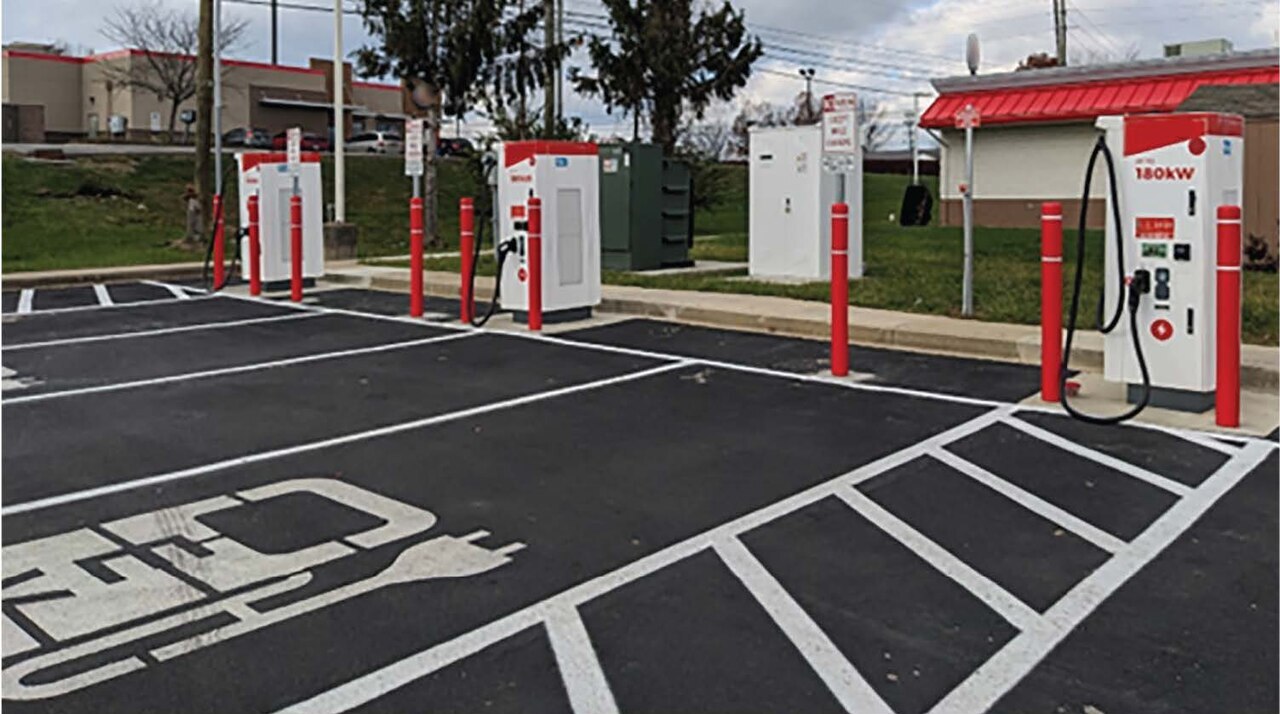
WYDOT's release says each NEVI station must have at least four charging ports, and that WYDOT is asking for at least two Level 3 fast charging ports at each location. Separately, WYDOT's NEVI page describes the baseline federal guidance as four DC fast chargers rated at 150 kW or higher per station, and says that requirement is more relaxed now that Wyoming has full build-out status. ChargerFeed has not reviewed the RFP itself, so bidders should confirm the exact port counts and power levels in the bid documents on PublicPurchase.
The state tax change bidders need to price in
Operators in Wyoming are also dealing with a new state tax structure. Cowboy State Daily reported that House Bill 145, which took effect July 1, does the following:
- Taxes only fast chargers at a flat 3.5 cents per kWh.
- Exempts electricity sold at fast chargers from sales tax.
- Requires fast chargers to be metered.
- Drops the annual registration fee for all-electric vehicles from $200 to $100.
Anyone modeling per-kWh pricing at a Wyoming NEVI site would need to account for that 3.5-cent tax. According to the reporting, the charging tax no longer applies to slower chargers.
Timeline at a glance
- 2025: FHWA grants Wyoming full build-out status on its I-25, I-80 and I-90 corridors (WYDOT).
- July 1, 2026: HB 145 fast-charger tax and registration-fee changes take effect (Cowboy State Daily).
- September 2026: WYDOT issues its first NEVI RFP (WYDOT; Casper Star-Tribune, Sept. 24, 2026).
- 11 a.m., Nov. 18, 2026: Proposals due, bid ID 216241 on PublicPurchase (WYDOT release via Casper Star-Tribune).
- After that: The sources reviewed do not give an award date or a construction schedule.
What It Means for Drivers
Nothing changes at the plug yet. WYDOT's NEVI page says no NEVI-funded chargers have been installed in the state thus far. This RFP asks for proposals. It does not approve projects, award funds or set construction dates. Drivers crossing the state on I-25, I-80 or I-90 should expect today's charging options to stay the same for now.
If projects are awarded, the siting rules shape where new stations could show up. Every NEVI-funded station must be within a three-mile driving distance of a corridor exit in its cluster, so drivers should not expect long detours to reach one. Because full build-out status lets Wyoming spend funds beyond the three interstates, and because nearly all areas of the state may take part, some stations could end up on other highways and in host cities. Where they go depends on which clusters bidders choose and which bids win.
The stations will be privately owned and operated, not run by WYDOT. Pricing, payment methods and upkeep would therefore fall to each operator, within whatever terms the grant agreements set. Under HB 145, electricity sold at fast chargers in Wyoming is taxed at 3.5 cents per kWh (Cowboy State Daily, Sept. 29, 2026), a cost operators will need to factor into their rates. Owners of all-electric vehicles also see a lower annual registration fee, $100 instead of $200, under the same law.
For site hosts and local partners thinking about a future round, any on-site electrical work belongs with a licensed electrician and the equipment manufacturer's instructions, along with the utility's interconnection process.
