
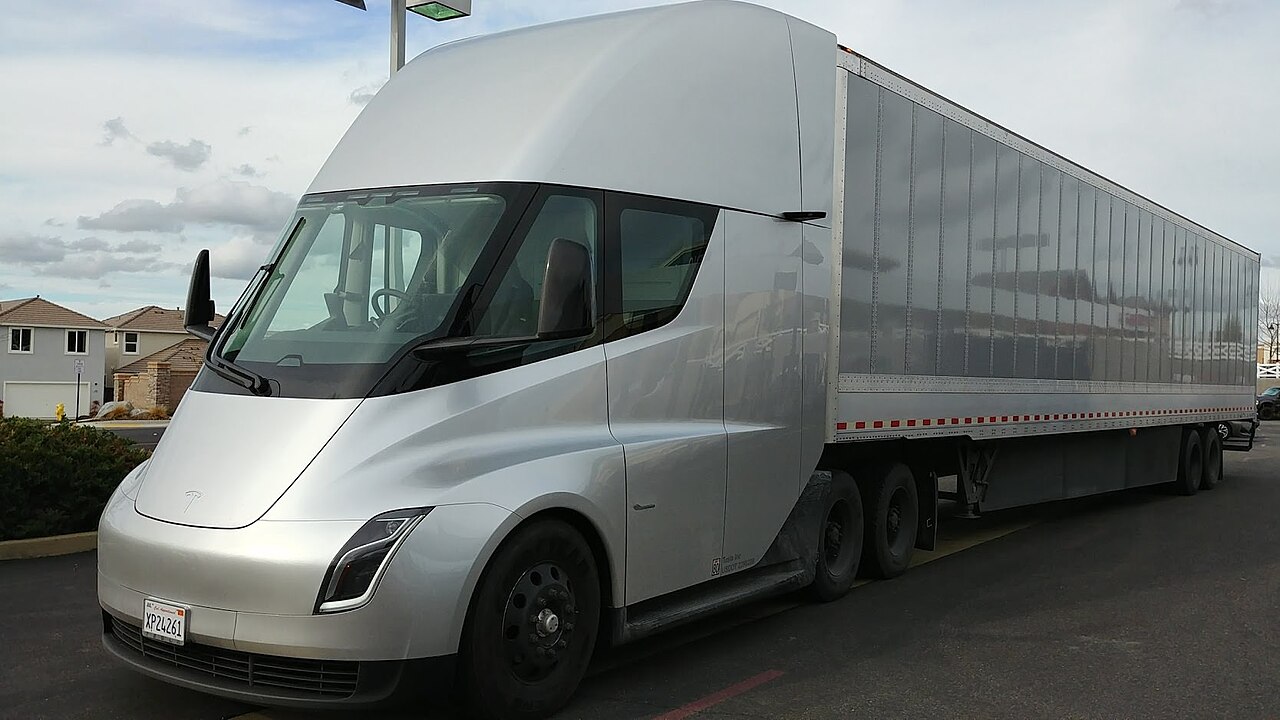
Tesla's third-quarter 2026 update, an exhibit to its Oct. 21 earnings release, contains a short line that matters for heavy-duty charging: "We began volume production of Tesla Semi." Further down, it says Tesla "deployed the first pre-assembled Megacharger to support the Tesla Semi ramp."
The filing leaves out one key number. Tesla did not say how many Semis it built or delivered in the quarter, as FreightWaves noted. The only volume figure is capacity. Tesla's production table lists the Nevada Semi line at 25,000 trucks of installed annual capacity, with the status "Production." Installed capacity is what a line is built to make, not what it is making now.
Below, we go through what the filing says, what it leaves out, and how the European Megacharger plan fits in.
What exactly did Tesla report?
The Q3 2026 update includes these facts relevant to charging:
- Semi production: volume production has begun. The Nevada line is listed at 25,000 units per year of installed capacity. No unit counts were given.
- Semi efficiency: Tesla says the top variant can go 500 miles at the full 82,000 lb gross combination weight while using 1.7 kWh per mile. Tesla says that means the Semi uses a third of the energy of a comparable diesel truck hauling the same payload.
- Megacharger: the first pre-assembled Megacharger has been deployed. Tesla did not say where it is, how many stalls it has, or its power rating.
- Accordion Supercharger: Tesla deployed its first "Accordion Supercharger." The company says this unit is "pre-assembled in the factory and cheaper to install." It gave no cost figures.
- Supercharger network: 8,904 stations and 84,465 connectors at the end of Q3 2026.
- Supercharger for Business: more than 600 stalls under the program. Tesla describes these as customer-owned chargers.
For financial context, FreightWaves reports Q3 revenue of $28.05 billion and GAAP net income attributable to common stockholders of $787 million. Both figures match the Tesla update.
What does "pre-assembled" change?
Tesla's filing makes one claim about both new products: they are pre-assembled before they reach the site. For the Accordion Supercharger, Tesla says this makes it cheaper to install. For the Megacharger, Tesla frames the pre-assembled unit as support for the Semi ramp.
Tesla gave no figures on cost, time to install, or power for either product. So this report can only say that both units exist and that Tesla says the factory-built approach is cheaper (for the Accordion Supercharger) and supports the Semi ramp (for the Megacharger). It is not yet possible to measure the effect. Site hosts thinking about either product should expect the usual site work, including utility service and permits, handled by licensed professionals. Nothing in the filing says those steps go away.
How do the Supercharger numbers compare?
The station and connector counts in the filing compare as follows (as of each quarter's end):
- Q3 2025: 7,753 stations, 73,817 connectors
- Q2 2026: 8,704 stations, 82,357 connectors
- Q3 2026: 8,904 stations, 84,465 connectors
By ChargerFeed's arithmetic, that is 200 net new stations and 2,108 net new connectors since Q2. Year over year, it is 1,151 more stations (about 14.8%) and 10,648 more connectors (about 14.4%). Sites have stayed about the same size: roughly 9.5 connectors per station in all three quarters. These are Tesla's overall Supercharger figures. The filing does not report Megacharger sites as a separate count.
What is planned for Europe?
Tesla showed its European Semi charging plan at the IAA Transportation show in Hannover, Germany, in September. As Drive Tesla Canada reported on Sept. 15, Tesla plans more than 100 Megacharger stalls, with a map shown at the event covering Germany, France, the United Kingdom, Sweden, the Netherlands and Belgium and additional countries expected to follow. Each stall would support the Megawatt Charging System (MCS) standard at up to 1.2 MW. The report says these public stalls are separate from the Megacharger and Basecharger units that fleet customers can buy for their own facilities.
On timing, FreightWaves reports that Tesla plans to begin deploying the 100-plus stalls in 2027. Tesla is targeting first European customer deliveries by the end of 2027, with demonstrations in the first half of 2027, according to Tesla's Dan Priestley at IAA.
Drive Tesla Canada describes the stalls as "set to be installed." Tesla's Q3 update does not mention European Megacharger sites. ChargerFeed treats the European network as planned, not operating, until Tesla confirms otherwise.
FreightWaves also reports a commercial link: Tesla was selected as the lead supplier for a 2,500-truck battery-electric Class 8 order announced in September and coordinated through ZET SCALE. FreightWaves does not say when those trucks would be delivered or how they would be charged.
How do the Semi figures fit with megawatt charging?
Tesla's numbers allow some rough math. These are ChargerFeed's calculations, not Tesla's statements. At 1.7 kWh per mile, a 500-mile run at full weight uses about 850 kWh. Drive Tesla Canada reports Tesla's claim that, at those power levels, the Semi can recover more than 60% of its range in around 30 minutes. Sixty percent of 500 miles is 300 miles, or roughly 510 kWh at the stated efficiency. Delivering that in half an hour takes an average of about 1 MW. That fits within the 1.2 MW per-stall maximum Tesla quotes for Europe. Drive Tesla Canada also notes that Tesla currently lists the European Semi's maximum charge rate at 800 kW, so real sessions depend on the truck, battery temperature, state of charge, and how power is shared at the site. The sources do not give charging curves.
The math shows why depot and corridor planners care about stall count and grid connection more than headline peak power. A site with several stalls each drawing around a megawatt at once needs a utility service sized for that load. Neither the filing nor the trade reports say how Tesla is sizing or sourcing power for its sites.
What It Means for Drivers
For passenger EV drivers, nothing changes right away. The 8,904 Supercharger stations and 84,465 connectors Tesla reported at the end of Q3 2026 are the same network drivers use today. The first Accordion Supercharger is a new hardware format, but Tesla has not said where it is or whether its charging specifications differ from existing units.
For Semi operators in North America, the filing confirms that volume production has begun and that the first pre-assembled Megacharger has been deployed. It does not say where public Megacharger access is available, how many sites are operating, or what charging costs. Tesla published no Megacharger pricing in the sources reviewed. Fleets should confirm site access and terms directly with Tesla.
For European fleet operators, the timeline as reported runs as follows: Semi demonstrations in the first half of 2027, more than 100 MCS-compatible Megacharger stalls planned during 2027, and first customer deliveries targeted by the end of 2027. All of these are plans. None are yet operating services. The stalls are reported to use the MCS standard, but the sources do not say whether non-Tesla trucks will be able to use them.
For site hosts, the Supercharger for Business program had more than 600 stalls as of the Q3 2026 update. Tesla's claim that factory pre-assembly lowers installation cost has no supporting figures yet. Any host considering hardware should work with its utility and a licensed electrician.
