
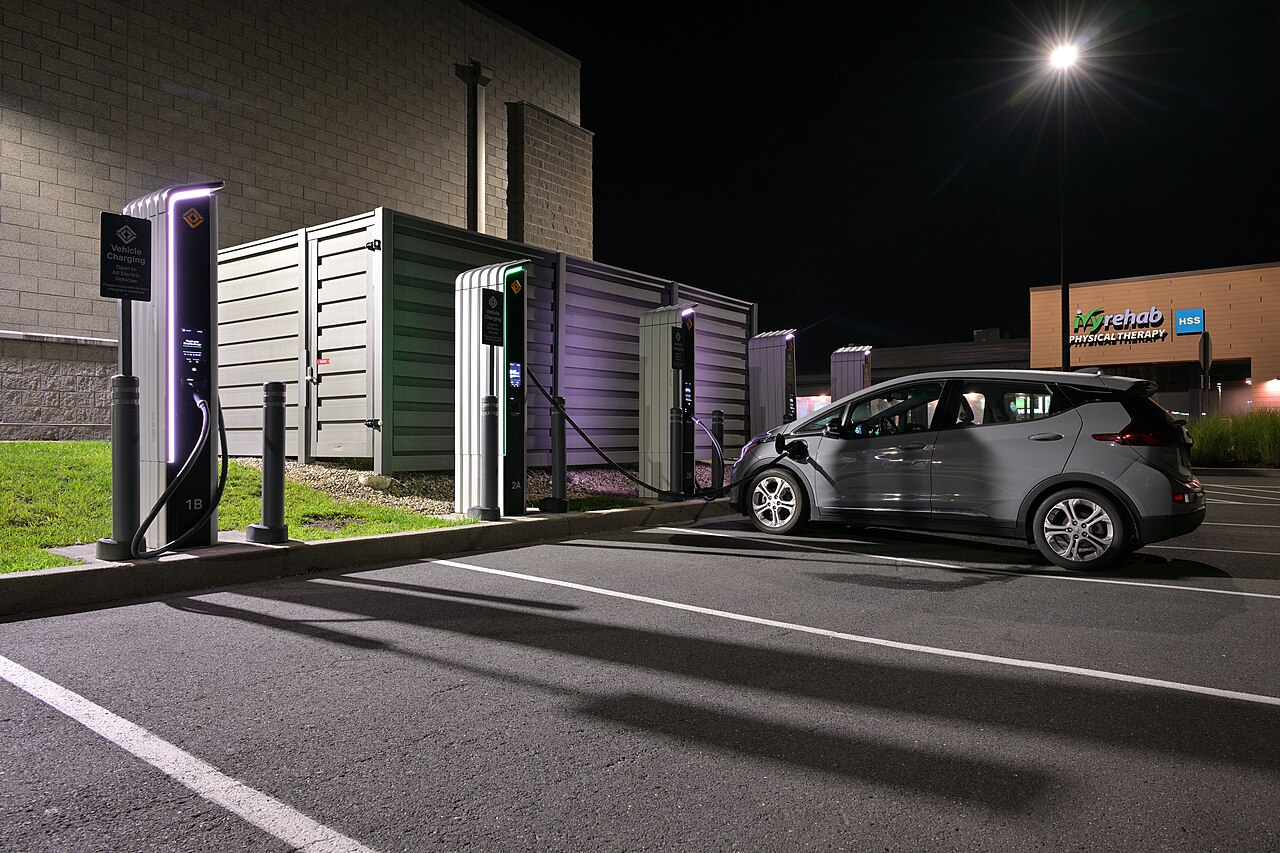
Rivian's fast-charging network had its biggest quarter yet for new stalls. The company's third-quarter 2026 earnings presentation, posted on SEC EDGAR as Exhibit 99.2 and dated October 29, 2026, lists the Rivian Adventure Network (RAN) at 1,185 chargers across 165 locations. A year earlier the figures were 850 chargers and 131 locations, so chargers are up 39% and sites are up 26%. A footnote in the deck says the counts are as of the earnings date, October 29, 2026.
An independent analysis from State Of Charge, published October 30 on EVChargingStations.com, puts the quarter's net growth at 10 new sites and 112 new stalls. State Of Charge calls that a record quarterly stall gain for the network, up 62% from the same quarter of 2025. The sites are also getting bigger. The average location now has about 7.2 stalls, compared with 6.5 a year ago.
Five quarters of growth
The earnings deck gives a sequential series for both metrics. The quarter-over-quarter changes below are ChargerFeed's arithmetic on Rivian's reported totals.
| Quarter | Locations | Net new locations | Chargers | Net new chargers |
|---|---|---|---|---|
| Q3 2025 | 131 | — | 850 | — |
| Q4 2025 | 141 | +10 | 937 | +87 |
| Q1 2026 | 145 | +4 | 973 | +36 |
| Q2 2026 | 155 | +10 | 1,073 | +100 |
| Q3 2026 | 165 | +10 | 1,185 | +112 |
Rivian added 335 chargers and 34 locations over the twelve months. Apart from a slow first quarter, when only four sites and 36 chargers came online, the network has added about ten sites a quarter. The number of chargers per quarter has grown faster than the number of sites, which is why the average site is getting larger. The third-quarter additions averaged a little over 11 chargers per new location. Some of those stalls may have gone into existing sites rather than new ones, and neither source breaks the total down that way.
A note on terms: Rivian's deck says "chargers" and State Of Charge says "stalls." Both describe the same totals (1,185 at 165 sites), and this article uses the two words interchangeably. The deck's counts are as of the earnings date, October 29, 2026. Neither source gives a breakdown of announced or under-construction sites, so this article doesn't estimate one.
How open is it to other EVs?
RAN began as a network for Rivian owners only. According to Rivian's R2 network page, published May 5, 2026, the company began opening the network to all electric vehicles in late 2024, and it says nearly every site now supports all compatible EVs. Rivian also says it is adding NACS (SAE J3400) connectors in addition to the existing CCS1 plugs and has added tap-to-pay terminals so non-Rivian drivers don't need an app.
State Of Charge checked how far that rollout has gotten using two separate data sources, both as of October 30, 2026:
- Open-access sites: Rivian Roamer data shows 161 of 165 sites (97.6%) open to all EVs. State Of Charge says four sites still require dispenser replacement.
- NACS connectors: The U.S. Department of Energy's Alternative Fuels Data Center (AFDC) lists 448 NACS stalls at 97 RAN locations. That is roughly 59% of sites and almost 38% of stalls.
Those two figures measure different things and shouldn't be confused. Nearly every site now accepts non-Rivian EVs, but about six in ten have NACS plugs, and about four in ten stalls do. State Of Charge breaks the connector mix down further: 33 sites (20%) are NACS-only, 64 (39%) have both NACS and CCS1, and 68 (41%) are CCS1-only. The AFDC is a public database that relies on networks reporting their stations, so its connector counts may lag behind what is actually installed. The 448 figure is a snapshot from October 30, not Rivian's own number.
Reliability and satisfaction claims
On its R2 network page, Rivian says it maintained 98% uptime across the network in 2025. That figure comes from the company. The page does not explain how it was measured, and ChargerFeed has not independently verified it. State Of Charge also reports that RAN became one of the top networks in J.D. Power's 2026 Public Charging Satisfaction ranking for DC fast-charging networks. Its analysis doesn't give RAN's exact position or score, so we don't report one.
Context from the rest of the earnings deck
The charging build-out is happening while the company's vehicle business grows. The same presentation reports record deliveries of 19,248 vehicles in the third quarter, up 46% from a year earlier, and revenue of $2,155 million, up 38%. These figures are included only to show the size of the company's business. This article is not investment advice.
Rivian's May 2026 R2 page ties the network's scaling to the arrival of R2 drivers and says the major underground infrastructure, such as conduits and power capacity, is already in place at most RAN locations, which it says allows new chargers to be added without heavy construction. That is Rivian's own description and ChargerFeed has not verified it. The provided sources don't give targets for future site counts, so ChargerFeed isn't projecting where the network will be at year-end.
What It Means for Drivers
If you drive a Rivian: You have more places to charge than a year ago: 165 sites and 1,185 stalls as of October 29, 2026, compared with 131 sites and 850 stalls in the third quarter of 2025. Larger sites, now averaging about 7.2 stalls, may mean more availability at busy locations, though neither source reports occupancy or wait-time data.
If you drive another brand of EV: According to State Of Charge's reading of Rivian Roamer data on October 30, 161 of the 165 sites accept non-Rivian vehicles. The other four require dispenser replacement, and the sources don't give a date for that work. Rivian says non-Rivian drivers can pay with tap-to-pay terminals. Before you rely on a specific site, confirm in your navigation or charging app that it's listed as open to all EVs.
Which plug you'll find: According to AFDC data from October 30, NACS connectors are installed at 97 of the sites, on 448 stalls in total. Rivian says it is adding NACS in addition to CCS1, and State Of Charge counts 64 sites with both connectors. At the 68 sites (41%) State Of Charge lists as CCS1-only, expect CCS1 only. Check the connector listing for your stop before you go, especially if your vehicle has a native NACS port and you don't carry an adapter, and note that 33 sites are NACS-only, so CCS1 vehicles should check as well.
Pricing: The provided sources don't include current per-kWh or per-minute rates for RAN, so ChargerFeed isn't quoting any. Rates can vary by site and by whether you're a Rivian owner. Check the price shown at the charger or in the app before you start a session.
Site hosts and fleets: The sources don't describe any changes to host agreements or fleet access programs. The main operational takeaway is that sites are getting bigger. Rivian is now putting more stalls at each location than it did a year ago, which affects what a host site needs in space and electrical capacity. Any site planning should be coordinated with the local utility and qualified professionals.
