
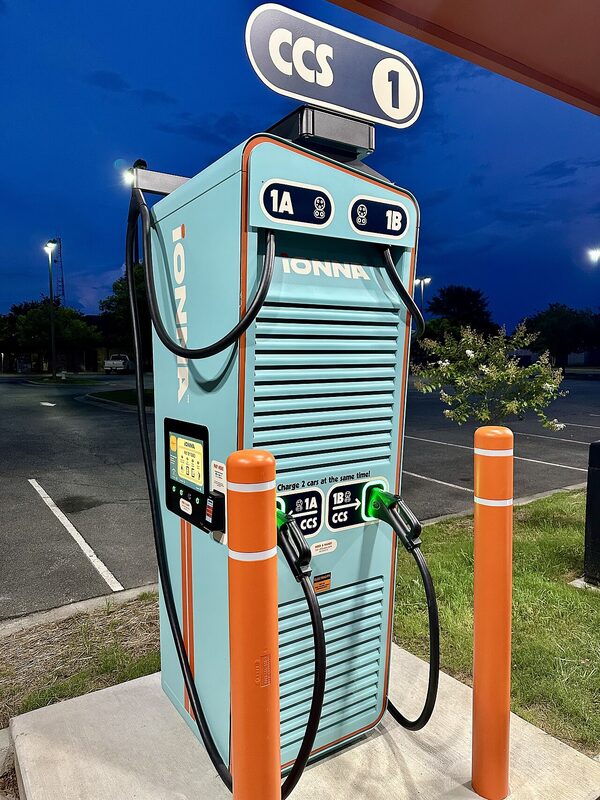
On Oct. 20, 2026, BMW Group, the charging network IONNA and the hardware maker Alpitronic held a media demonstration in Southern California. The new BMW iX5 60 xDrive is rated for charging at up to 460 kW, and trade press reported a brief displayed peak of 464 kW. BMW's own release adds a qualifier that matters as much as the headline number: the 460 kW experience "is a technology demonstration and does not represent charging hardware commercially available in the U.S. today."
So what happened, which figures hold up, and what does it mean for someone planning to buy or host chargers for this vehicle? The questions below go through it.
What exactly was demonstrated?
According to BMW's US press release, dated Oct. 20, 2026 from Woodcliff Lake, N.J., the iX5 60 xDrive is rated for a peak DC charging power of up to 460 kW. Alpitronic supplied the charging equipment and IONNA contributed what ElectricCarsReport calls its charging network expertise. Electrek reports that the demo took place at an IONNA charger running Alpitronic hardware, and that the vehicle hit a peak of 464 kW during the event.
ElectricCarsReport also reported that the vehicle "briefly displayed" 464 kW, a little above BMW's 460 kW rating. Both outlets describe the figure as a peak, not a sustained rate. ElectricCarsReport notes that real-world performance depends on battery temperature, state of charge and the output of the charger.
What's inside the car that makes this possible?
BMW says the iX5 60 xDrive uses its sixth-generation (Gen6) eDrive system, built on 800-volt technology with cylindrical battery cells. BMW says these cells deliver 20% greater energy density than the prismatic cells of its Gen5 technology. The company gives the pack's net capacity as 144 kWh. ElectricCarsReport describes the same figure as 144 kWh usable.
How fast is it, really? The numbers don't all match
The published sources disagree on the headline charging claims, so here they are side by side.
- BMW's US release (Oct. 20, 2026): up to 182 miles of range added in 10 minutes (EPA), and 10–80% state of charge in 23 minutes. A footnote says these are estimated numbers based on BMW AG testing using EPA test procedures.
- Electrek and ElectricCarsReport: 170 miles in 10 minutes, and 10–80% in about 22 minutes.
ChargerFeed uses BMW's own US release figures (182 miles, 23 minutes) as the primary numbers, because that document is the manufacturer's official US statement. The gap between the sources has not been explained in any of them. The "EPA" label also needs care. BMW's footnote says its figures are estimates from its own testing using EPA procedures, ElectricCarsReport describes them the same way, and Electrek says official EPA figures for the vehicle are still pending. Until the EPA publishes its ratings, treat every range-per-minute number as a manufacturer estimate.
For context, here is a ChargerFeed calculation, not a figure from BMW. Going from 10% to 80% of a 144 kWh net pack adds about 101 kWh. Doing that in 23 minutes works out to an average of roughly 263 kW over the session. That is well below the 460 kW peak, which fits with both trade outlets describing the higher figure as a short peak rather than a steady rate.
Why does BMW say the hardware isn't available?
BMW's release says plainly that the 460 kW experience does not represent charging hardware commercially available in the US today. Electrek makes the same point, writing that the US does not have the hardware to support 460 kW charging. None of the sources says when, or whether, hardware matching the demo will be sold or installed at public US sites. None of them names a deployment schedule for IONNA locations either. The event should be read as a demonstration of what the vehicle can accept. It was not an announcement of new chargers, and it was not an announcement of upgrades to existing ones.
Who are IONNA and Alpitronic?
BMW describes IONNA as a joint venture founded by eight automakers: BMW, General Motors, Honda, Hyundai, Kia, Mercedes-Benz, Stellantis and Toyota. The release does not give a station or port count for IONNA.
Alpitronic is the hardware supplier. In the Oct. 20, 2026 release, BMW's boilerplate about Alpitronic cites more than 125,000 charging ports installed and 223 million charging sessions. These are cumulative figures as stated in that release. They are not broken out by country, and ChargerFeed has not independently verified them.
When does the car go on sale, and for how much?
Electrek reports that the 2027 iX5 60 xDrive is scheduled to launch in the US in the first quarter of 2027, with a starting price of $79,800 (as reported by Electrek on Oct. 20, 2026). ElectricCarsReport gives the same launch window and price, plus a $1,450 destination and handling charge. Electrek also reports that BMW is set to begin production at its Spartanburg, S.C., plant by the end of 2026. Both are planned dates and could change. The car is not yet on sale.
What It Means for Drivers
For prospective iX5 buyers, the main point is that the vehicle's rated charging ceiling is higher than the charging hardware BMW says is commercially available in the US today. When the car launches, which Electrek reports as Q1 2027, the charging speed drivers actually get will depend on the charger they plug into. It will also depend on the factors ElectricCarsReport lists: battery temperature, state of charge and charger output. The 182-mile and 23-minute figures from BMW are best-case manufacturer estimates pending EPA ratings, and the trade press reported slightly lower numbers.
For site hosts and fleet operators, nothing in the sources announces new hardware, pricing or availability for 460 kW-class chargers in the US. The demo shows that vehicles able to take very high peak power are coming. Any decision about upgrading or installing equipment should rest on products that are actually available, the manufacturer's specifications, and a licensed electrician and utility consultation for site work. It should not rest on a demonstration unit.
For IONNA users, the sources do not say that any public IONNA location now offers 460 kW charging. The demo used Alpitronic equipment at an IONNA charger, and BMW labels that setup a technology demonstration.
Sources
- BMW Group, IONNA and Alpitronic Join Forces to Demonstrate High-Power Charging: Up to 460 kW for the New BMW iX5 60 xDrive (BMW PressClub USA, Oct. 20, 2026)
- BMW iX5 hits up to 460 kW during first public fast-charging demo (Electrek, Oct. 20, 2026)
- BMW iX5 Demonstrates 460 kW Charging, Targets 170 Miles in 10 Minutes (ElectricCarsReport)
