
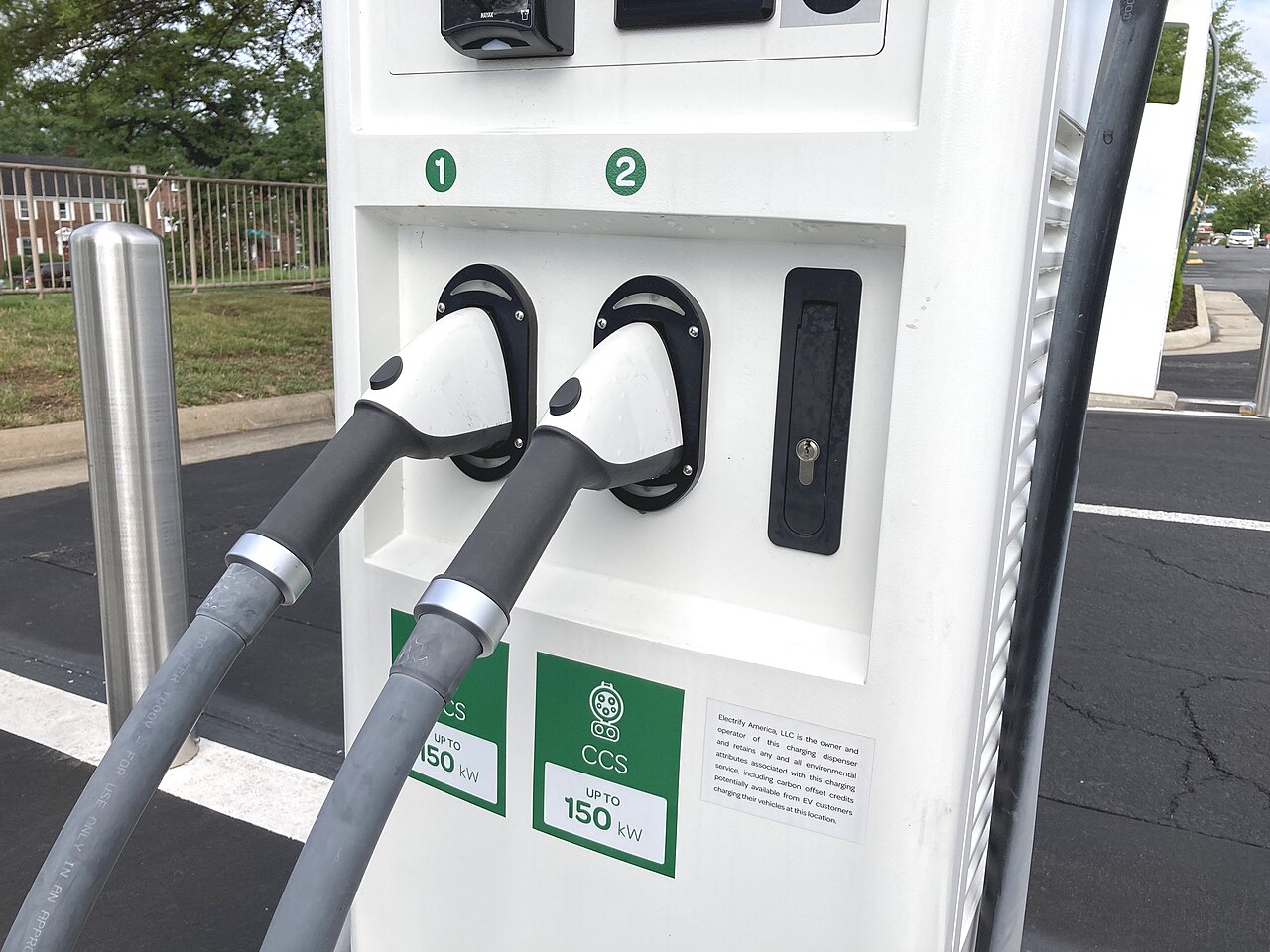
North America is partway through a connector change. For most of the last decade, a non-Tesla EV used one plug for slow charging and a larger version of it for fast charging, while Tesla used its own. Now most automakers have committed to Tesla's design, standardized by SAE International as J3400, and heavy trucks are getting a megawatt-class plug of their own. This guide explains the four names you will see on charger screens, maps and spec sheets, where each is used, and what the federal rules for publicly funded chargers require. Figures are as of October 2026 unless noted, and are drawn from the U.S. Department of Energy's Alternative Fuels Data Center (AFDC), the Joint Office of Energy and Transportation, the federal rule for funded chargers, CharIN and charging-data firm Paren.
The short version
| Name | What it is | Used for | Who uses it |
|---|---|---|---|
| J1772 | SAE's AC connector | Level 1 and Level 2 (AC) | Non-Tesla EVs; Teslas use it through an included adapter |
| CCS1 (Combined Charging System) | J1772 plus two DC pins | AC and DC fast charging through one inlet | Most non-Tesla EVs to date; required on federally funded fast chargers |
| NACS / SAE J3400 | Tesla's connector, opened and standardized by SAE | AC and DC through the same pins | Tesla; most other automakers committed to it starting in 2025 |
| MCS (Megawatt Charging System) | A separate, much larger DC connector | Medium- and heavy-duty trucks and buses | Class 6–8 commercial vehicles |
A fifth name, CHAdeMO, still appears on older fast chargers. The AFDC describes it as a DC connector common among Japanese automakers. It is fading: Paren's Q3 2026 fast-charging report puts CHAdeMO at about 17% of non-Tesla fast-charging ports and says its share "continues to slip."
J1772 and CCS1: the incumbent pair
SAE J1772 is the AC plug. According to the AFDC, the portable Level 1 cord that comes with most EVs has a standard household NEMA plug on one end and a J1772 connector on the other, and Level 2 equipment uses the same J1772 connector. The AFDC states that all commercially available EVs in the United States can charge on Level 1 and Level 2 equipment.
CCS1, also called the J1772 combo, extends that plug for DC. The Joint Office's connector primer describes it as the same five-pin J1772 layout "with two additional bottom 'DC' pins for use with a DCFC." One inlet on the car therefore handles Level 1, Level 2 and DC fast charging. The primer adds that CCS1 was developed "over a decade of deliberation and field testing," and that every non-Tesla EV produced through 2024 would continue to have a CCS1 port, which is why CCS1 cables will stay on public chargers for years.
NACS and J3400: same plug, two names
NACS (North American Charging Standard) is the name Tesla gave its connector when it opened the design to other manufacturers in November 2022, according to the Joint Office's timeline. J3400 is the SAE standard built from it. In practice, a "NACS port" and a "J3400 port" are the same physical interface; J3400 is the SAE standard's designation for it.
The design difference from CCS1 is that NACS uses the same pins for AC and DC power transfer, so a single compact plug covers every charging level. The milestones, per the Joint Office primer and its Oct. 9, 2024 announcement:
- November 2022: Tesla renames its connector NACS and opens the standard to other EV makers in North America.
- June 2023: SAE announces it will standardize NACS through an expedited J3400 task force of more than 120 public- and private-sector experts.
- December 2023: SAE publishes the J3400 Technical Information Report.
- 2024: SAE's EV Coupler Task Force votes to establish J3400 as a Recommended Practice; the Joint Office announced its support for the newly released Recommended Practice on Oct. 9, 2024.
On paper, J3400 has headroom. The Joint Office's adapter-compatibility page says the connector is rated for DC supply at up to 1,000 volts and up to 1,000 amperes "with adequate cooling," and that it can accept 277-volt AC supply, which could lower the cost of AC charging at commercial sites with 480-volt three-phase service. It also lists vehicle-to-grid energy transfer among the capabilities J3400 opens up.
Adoption on the infrastructure side is real but partial. Paren counted 677 NACS ports installed by non-Tesla networks in the third quarter of 2026, 23% of their new connectors, roughly flat from 22% in Q2 and up from 9% a year earlier; CCS still made up 74% of new non-Tesla builds. Across the installed base, NACS accounts for about 9% of non-Tesla ports, Paren says. Some networks have started building NACS-only sites, including Ionna in Lancaster and Perris, California, and Rivian in Florida and Colorado. Going the other way, Tesla has opened Supercharger sites that list CCS1 connectors alongside J3400 on each port; ChargerFeed covered four such California sites this fall.
Adapters during the transition
Because CCS1 and J3400 vehicles will share the road for years, adapters bridge the gap. The Joint Office says that, until certified adapters under the forthcoming UL adapter standard are widely available, drivers "should only use adapters provided by their vehicle manufacturer for their specific vehicle and use them as instructed," and notes that not all adapters work with all vehicle and charger combinations. The National Charging Experience (ChargeX) Consortium published a separate report, Recommended Actions to Improve Adapter Safety, after a failure-mode analysis of adapters.
On the AC side, the AFDC notes that Tesla vehicles come with a J1772 adapter for non-Tesla Level 2 equipment. Station-mounted solutions also exist: the Joint Office cites Tesla's Magic Dock, a NACS-to-CCS1 adapter attached at the Supercharger, as an example.
What federally funded chargers must offer
For stations built with National Electric Vehicle Infrastructure (NEVI) Formula funds and other Title 23 highway money, the connector rules are in 23 CFR 680.106(c):
- Each DC fast-charging port must be able to charge any CCS-compliant vehicle and must have at least one permanently attached CCS Type 1 connector.
- Permanently attached CHAdeMO connectors may be added only with fiscal 2022 NEVI funds.
- Each AC Level 2 port must have a permanently attached J1772 connector.
J3400 is allowed alongside CCS1. The Joint Office's takeaway is that "federally funded EV chargers can include a J3400 connector if there is also a CCS1 connector that meets the minimum requirements," and that a station-integrated adapter can qualify if it is permanently attached and the station meets all of Part 680. Arizona, for example, said when it announced its first three NEVI-funded openings that most of its stations will have both NACS and CCS plugs.
MCS: the truck plug
The Megawatt Charging System is a different connector, not a faster version of CCS or NACS. CharIN, the industry association that developed it, describes a single conductive plug rated to a maximum of 1,250 volts and 3,000 amperes DC, communicating over Ethernet with ISO/IEC 15118-20, designed for Class 6, 7 and 8 commercial vehicles and placed on the left side of the vehicle at roughly hip height. CharIN says it is designed to be handled manually by a driver but is "capable of being automated," and lists bidirectional (V2X) capability. Multiply the voltage and current ceilings and you get 3.75 megawatts, the figure the AFDC gives for MCS, which it ties to the SAE J3271 standard.
MCS is not something passenger-car owners will plug in. The point for fleet managers is that heavy-duty sites need their own hardware, utility planning and, often, separate funding. ChargerFeed has tracked the standards work, including the IEC megawatt charging standard CharIN says completes the framework, and the first Pilot and Tesla Megacharger sites.
What It Means for Drivers
- Check your inlet, not your brand. The Joint Office says non-Tesla EVs produced through 2024 would continue to have CCS1 ports, and the AFDC notes that some Japanese models use CHAdeMO for DC. Newer models may have a J3400 port; the vehicle's manual and the automaker are the authority.
- Level 2 is the easy part. J1772 remains the standard public AC plug, and the AFDC says every commercially available U.S. EV can use Level 1 and Level 2 equipment; Tesla vehicles ship with a J1772 adapter for it.
- Federally funded fast chargers will keep CCS1. Part 680 requires a permanently attached CCS1 connector on every NEVI DC port. J3400 cables are allowed in addition, so expect more stations with both.
- Use the right adapter. Until certified adapters are common, the Joint Office advises using only the adapter your automaker provides for your vehicle.
- Filter maps by connector. The Joint Office's federal station map shows every network and connector type by default and can be filtered, which is the quickest way to see where your car can plug in without an adapter.
Sources
- Alternative Fuels Data Center — Developing Infrastructure to Charge Electric Vehicles (charging levels and connectors) (accessed Oct. 23, 2026)
- Joint Office of Energy and Transportation — Charging connector primer: NACS, J3400 and NEVI requirements (accessed Oct. 23, 2026)
- Joint Office of Energy and Transportation — EV Charging Connector and Adapter Compatibility (accessed Oct. 23, 2026)
- Joint Office of Energy and Transportation — Support for the newly released SAE J3400 EV Coupler Recommended Practice (Oct. 9, 2024)
- eCFR — 23 CFR Part 680, National Electric Vehicle Infrastructure Standards and Requirements (current text, accessed Oct. 23, 2026)
- Joint Office of Energy and Transportation — EV charging station map (accessed Oct. 23, 2026)
- CharIN — Megawatt Charging System (MCS) (accessed Oct. 23, 2026)
- Paren — US EV Fast Charging, Q3 2026 (Oct. 13, 2026)
