
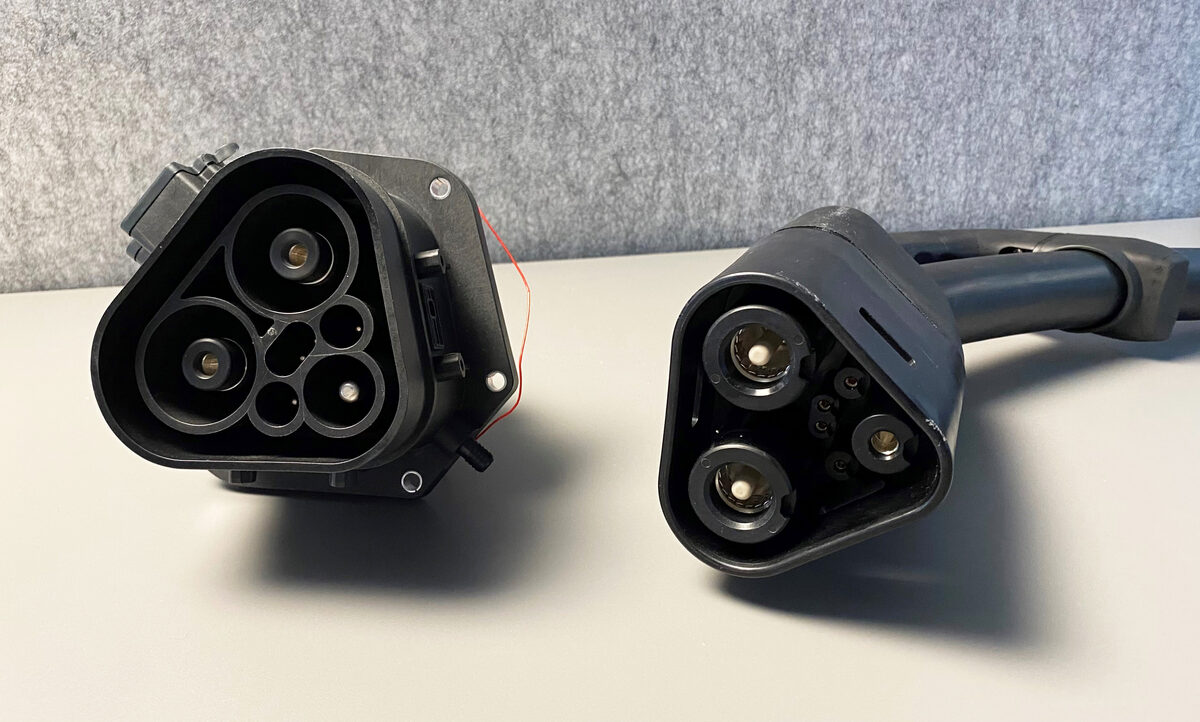
The International Electrotechnical Commission has published IEC 61851-23-3:2026, the standard for DC charging equipment used in megawatt charging systems (MCS). Edition 1.0 is dated Aug. 21, 2026. Forty days later, on Sept. 30, the charging-industry association CharIN announced that the document completes the MCS standards framework.
The document's full title is "Electric vehicle conductive charging system - Part 23-3: DC electric vehicle supply equipment - Megawatt charging systems." It is an International Standard from IEC Technical Committee 69 and runs 148 pages. As of Oct. 20, 2026, the IEC webstore lists it at CHF 430 for a single-user licence, in electronic and hardcopy formats.
What the standard covers
IEC 61851-23-3 sets requirements for the charging equipment itself, which the IEC calls the EV supply equipment. Its scope is defined in terms of two sides of the charger. On side A, the supply network side, the standard covers rated maximum voltages up to 1,000 V AC or 1,500 V DC. On side B, the EV side, it covers up to 1,250 V DC. It specifies systems with protective separation between sides A and B, and equipment fitted with a coupler defined in IEC TS 63379. Vehicles mated to this equipment are covered by Annex B of ISO 5474-3:2024.
Digital communication between charger and vehicle for control of energy transfer is defined in ISO 15118-10 and ISO 15118-20. In CharIN's breakdown, ISO 15118-10 handles the physical and data-link layers for automotive Ethernet, while ISO 15118-20 AMD1 handles communication and energy-transfer control.
The first edition also leaves some things out. The IEC listing says requirements for bidirectional power flow systems are under consideration, as are systems other than MCS that use the IEC TS 63379 coupler. Equipment built to the standard is not intended to deliver energy to a single EV through multiple vehicle connectors of the same equipment, or through multiple pieces of equipment; requirements for those cases are also under consideration. The document does not cover all safety aspects related to maintenance.
How the pieces fit together
MCS is not defined by a single document. CharIN treats IEC 61851-23-3 as the piece that completes a set divided among several standards bodies:
| Document | Role in MCS |
|---|---|
| IEC 61851-23-3:2026 | MCS DC EV supply equipment requirements |
| IEC TS 63379 | Connector, vehicle inlet and cable assembly |
| ISO 15118-10 | Physical and data-link layers for automotive Ethernet communication |
| ISO 15118-20 AMD1 | Communication and energy-transfer control between EV and charger |
| ISO 5474-3 | Requirements for EVs using DC power transfer, including MCS |
| SAE J3271 | Overall MCS system and use cases; currently a Technical Information Report |
"The publication of IEC 61851-23-3 marks a pivotal moment for the Megawatt Charging System," Semih Tetik, CharIN's technical project manager, said in the announcement. Erika Myers, executive director of CharIN North America, said completing the framework is an "important step toward moving megawatt charging from demonstration projects to widespread commercial deployment."
What happens next
Tetik named conformance testing, certification and interoperability validation as the priorities for the next phase. Those are the processes that check whether a specific charger or vehicle actually meets the published documents and works with other vendors' hardware. Myers said CharIN North America has engaged with policymakers to include the MCS standards in new and existing infrastructure funding programs, without naming specific programs.
One test event is already on the calendar, focused on a single layer of the stack. The CharIN ISO 15118-20 Controller Testival North America 2026 takes place Nov. 17-18, 2026, at the Cal EPIC Innovation Hub in Sacramento, Calif. CharIN's announcement lists it alongside a CharIN MCS Workshop in Sacramento, with the two events spanning Nov. 17-19. At the testival, participants bring EV communication controller (EVCC) and supply equipment communication controller (SECC) implementations and cross-test them against other vendors' equipment. The event listing says attendees will be "engineering staff from charger and vehicle suppliers, controller vendors and test labs."
What It Means for Drivers
The publication sets out requirements for equipment. It does not open any charging site. For fleets and truck drivers planning around megawatt charging, the practical points are these:
- One coupler design. Equipment built to IEC 61851-23-3 uses the IEC TS 63379 coupler, and vehicles mated to it fall under ISO 5474-3:2024, Annex B. When comparing trucks or depot hardware, ask the vendor whether the inlet or connector is built to IEC TS 63379.
- No vehicle-to-grid basis yet. Because bidirectional requirements are still under consideration, a fleet that wants to send energy back from vehicles over an MCS connection cannot point to this edition as the basis for doing so.
- One truck, one connector. Setups that would feed a single vehicle from two connectors or two chargers at once fall outside this edition.
- Ask about testing, not only compliance claims. When depot or truck-stop operators evaluate MCS chargers, they can ask which conformance or certification testing a unit has passed against IEC 61851-23-3 and ISO 15118-20 AMD1.
- Check grant rules directly. Before counting on grant support for MCS hardware, check the specific funding program's current technical requirements, since CharIN North America's push to include MCS standards in those programs is still under way.
