
Every EV charger in the United States falls into one of three tiers: Level 1, Level 2 or DC fast charging. The labels describe how power reaches the battery, and they translate into very different charging times, equipment costs and prices per kilowatt-hour. This guide sets out typical speeds and costs for each tier, using figures from the U.S. Department of Energy's Alternative Fuels Data Center (AFDC), the Energy Information Administration and industry pricing data. Prices and counts are dated, because they change. All charging times are approximate: the AFDC notes that real-world times depend on the battery's state of charge and capacity, the battery type, the vehicle's onboard charger and the charging equipment.
The three tiers at a glance
| Tier | Power source | Typical power | Range added (AFDC estimate) | Where you find it |
|---|---|---|---|---|
| Level 1 (AC) | 120 V household outlet | About 1.9 kW | About 5 miles per hour of charging | Home, some workplaces |
| Level 2 (AC) | 240 V (homes) or 208 V (commercial) | 2.9 to 19.2 kW | About 25 miles per hour of charging | Home, workplace, retail, curbside |
| DC fast | Usually three-phase AC input, converted to DC at the charger | Up to 500 kW | About 100 to 200+ miles per 30 minutes | Highway corridors, charging hubs |
The AFDC's range estimates rest on stated assumptions: the Level 1 figure assumes 1.9 kW of charging power, and the DC figure varies by vehicle and state of charge. As of the AFDC's Oct. 23, 2026 station count, the U.S. had 262,400 public charging ports at 83,449 station locations, not counting temporarily unavailable stations: 693 Level 1, 182,551 Level 2 and 79,144 DC fast. By ChargerFeed's arithmetic, that is about 69.6% Level 2, 30.2% DC fast and 0.3% Level 1.
Level 1: slow, but often enough
Level 1 uses a 120-volt AC plug. According to the AFDC, most EVs come with a portable Level 1 cordset, with a standard household NEMA plug on one end and a J1772 connector on the other, so no additional charging equipment is required. The AFDC's example: eight hours of charging at 120 V replenishes about 40 miles of range for a mid-size EV.
That sounds slow, and it is, but daily driving is the test that matters. The AFDC's home charging page says many EV owners can meet their daily driving needs by charging overnight on Level 1, "requiring no additional cost or installation," provided an outlet on a dedicated branch circuit is available near where they park. Where Level 1 falls short: long commutes, irregular schedules and large batteries that need more than one night to refill.
Equipment cost: the AFDC cites a range of $0, when the included cordset is enough, to $900 for residential Level 1 equipment.
Level 2: the everyday workhorse
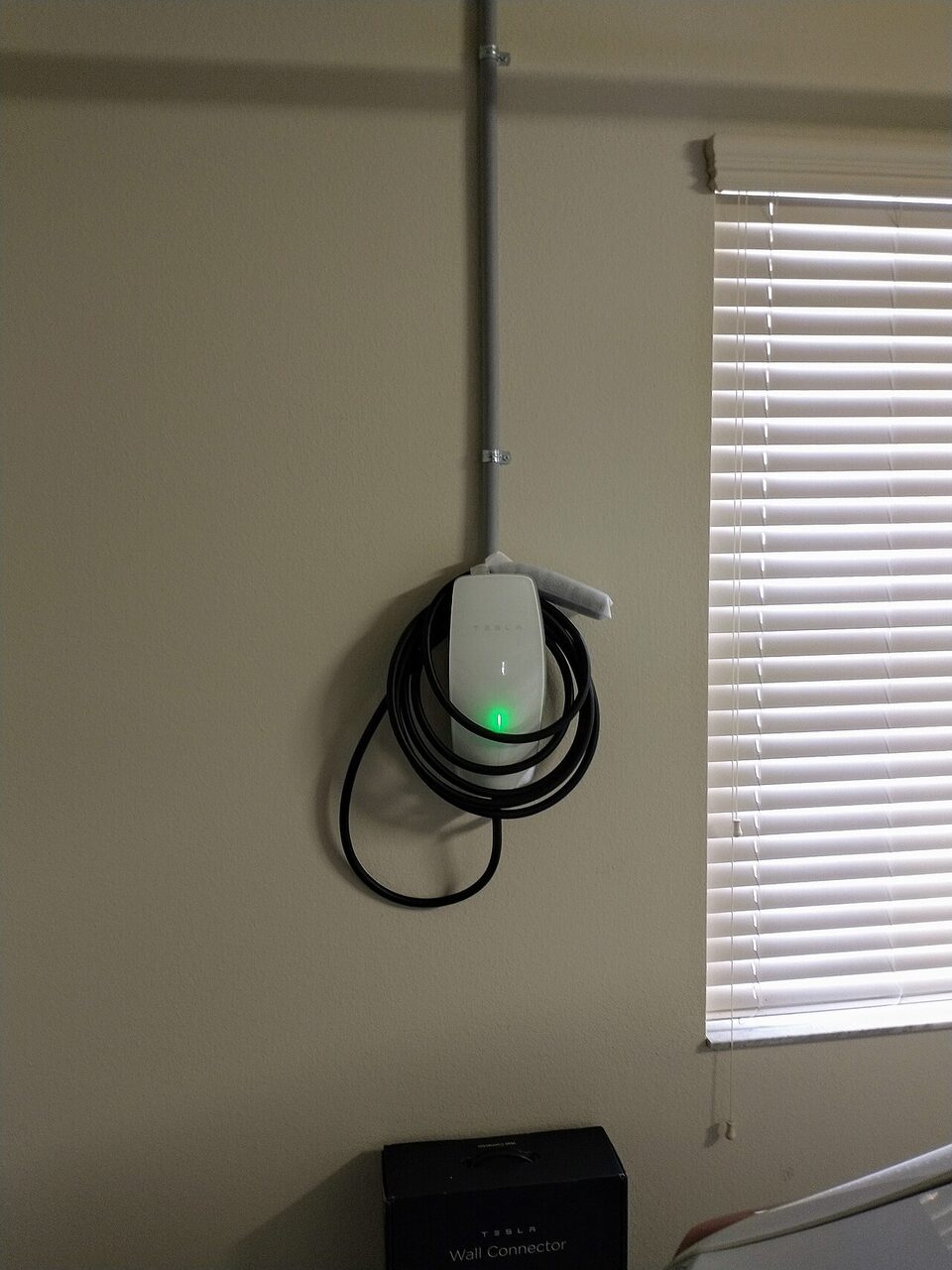
Level 2 runs on 240 V in most homes and 208 V at most commercial sites. The AFDC puts Level 2 output at 2.9 to 19.2 kW and says most residential Level 2 chargers deliver 7.2 kW. Level 2 equipment used for public and workplace charging can operate at 40 to 80 amps, the AFDC says. At 7.2 kW, eight hours overnight delivers about 57.6 kWh to the charger, before charging losses, which is enough to refill the AFDC's example 54 kWh battery from empty.
The AFDC's rule of thumb is about 25 miles of range per hour of Level 2 charging. In practice the vehicle sets the ceiling: the AFDC lists the vehicle's internal charger capacity among the factors that determine charging time, so a higher-rated wall unit does not always charge faster. For fleets and commercial sites, the AFDC also points to SAE J3068, a 2018 standard for higher-power AC charging on three-phase service that targets 6 to 130 kW.
Equipment and installation: the AFDC, citing a Rocky Mountain Institute report, puts residential Level 2 hardware at $380 to $690. National-lab figures it cites put residential Level 2 installation at about $1,300 per connector, excluding labor and permitting, while public Level 2 equipment runs about $3,500 per connector and public and workplace Level 2 installation averages about $2,500 per connector. Whether a home's electrical service can support Level 2 is a question for a licensed electrician; the AFDC notes that some homes may lack the electrical capacity for Level 2, that installations must meet local codes and permits, and that the work should be done by a certified electrical contractor.
DC fast charging: road-trip speed
DC fast chargers, which typically take a three-phase AC input, supply direct current to the vehicle; the AFDC says they are also referred to as Level 3 charging. It lists outputs up to 500 kW and estimates 100 to 200+ miles of range per 30 minutes. It also notes that many EVs on the road today are not capable of charging at rates higher than 200 kW, so a 350 kW or 500 kW cabinet does not guarantee a faster session.
The hardware keeps getting more powerful. Paren's Q3 2026 report found that 73% of fast-charging ports installed in the quarter are rated at 250 kW or more, up from 60% a year earlier, and that 35% of new non-Tesla ports are rated 400 kW or higher. About one in eight new installs is still below 150 kW.
Equipment and installation: the AFDC cites $38,000 to $90,000 per connector for DC fast equipment, with higher costs at higher power, plus $20,000 to $60,000 per connector for installation, depending on charger power and how many units share a site. Those costs are a large part of why public fast charging costs more per kWh than home electricity.
What a charge costs
The formula is the same for every tier: price per kWh times kWh used. The AFDC's worked example uses an EV that consumes 27 kWh per 100 miles and a 54 kWh battery that gives about 200 miles of range. Applying the prices below to those assumptions gives the figures in the table (ChargerFeed's arithmetic: 0.27 kWh per mile times the price, and 54 kWh times the price; before charging losses, taxes, idle fees and membership fees):
| Where you charge | Price used | Cost per mile | Full 54 kWh charge |
|---|---|---|---|
| Home, U.S. average residential rate | 18.31¢/kWh (EIA, July 2026) | About 4.9¢ | About $9.89 |
| Public DC fast, national average | $0.540/kWh (Paren, Q3 2026) | About 14.6¢ | About $29.16 |
| Public DC fast, time-of-use off-peak average | $0.438/kWh (Paren, Q3 2026) | About 11.8¢ | About $23.65 |
| Public DC fast, time-of-use peak average | $0.637/kWh (Paren, Q3 2026) | About 17.2¢ | About $34.40 |
The residential rate comes from the EIA's Electric Power Monthly, which put the U.S. average at 18.31 cents per kWh in July 2026, up from 17.45 cents a year earlier. State averages range widely; the same table shows 15.03 cents in Florida and 33.61 cents in California. Time-of-use home rates, offered by some utilities, can lower the cost further, the AFDC notes.
Fast-charging prices vary by network, site, membership and time of day. Paren puts Tesla's average at $0.396/kWh for members and $0.569/kWh for non-members in Q3 2026, and reports state averages from $0.424/kWh in Nebraska to $0.877/kWh in Hawaii. Electrify America, for example, says on its pricing page that price depends on location, plan and energy delivered, shows real-time pricing in its app and on the charger screen, offers time-of-use pricing at select stations, may charge idle fees, and says its Pass+ subscribers save about 25%. ChargerFeed's coverage of the Paren report has more detail on network pricing.
What It Means for Drivers
- Home charging is the default for most owners. The AFDC says most EV drivers charge overnight at home on Level 1 or Level 2. If Level 1 covers your daily miles, the added hardware may not be needed.
- Plan installs with a professional. Level 2 at home may require electrical upgrades, a permit and an inspection. Get a licensed electrician to assess the panel, and check with your utility for rebates or time-of-use rates.
- Fast charging costs roughly three times as much per mile. At Q3 2026 averages, DC fast charging ran about 14.6¢ per mile against about 4.9¢ at the July 2026 average home rate, using the AFDC's efficiency assumption. Memberships and off-peak pricing narrow the gap.
- The car sets the speed limit. A 350 kW charger will not exceed what your vehicle accepts, and the AFDC notes that charging power varies with the battery's state of charge.
- For fleets and site hosts: AFDC cost ranges are about $6,000 per public Level 2 connector installed versus roughly $58,000 to $150,000 per DC fast connector. Match the tier to dwell time: Level 2 where vehicles park for hours, DC fast where they cannot.
Sources
- Alternative Fuels Data Center — Developing Infrastructure to Charge Electric Vehicles (charging levels, speeds, connectors) (accessed Oct. 23, 2026)
- Alternative Fuels Data Center — Procurement and Installation for EV Charging Infrastructure (equipment and installation costs) (accessed Oct. 23, 2026)
- Alternative Fuels Data Center — Charging Electric Vehicles at Home (accessed Oct. 23, 2026)
- Alternative Fuels Data Center — Alternative Fueling Station Counts by State (last updated Oct. 23, 2026)
- U.S. Energy Information Administration — Electric Power Monthly, Table 5.6.A, average price of electricity by state (July 2026 data)
- Paren — US EV Fast Charging, Q3 2026 (Oct. 13, 2026)
- Electrify America — Pricing and Plans for EV Charging (accessed Oct. 23, 2026)
