
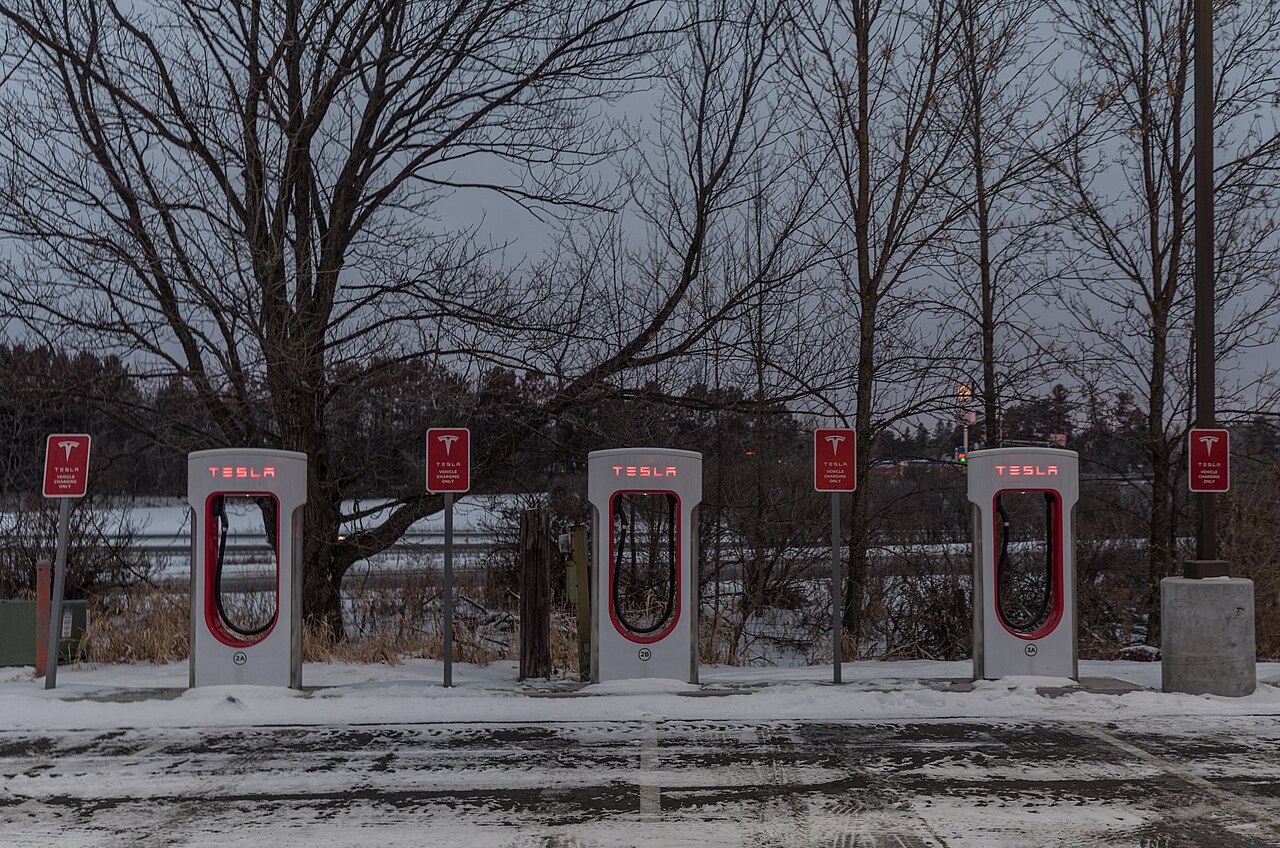
The National Electric Vehicle Infrastructure (NEVI) Formula Program is a $5 billion federal formula program for public EV fast chargers, built first along designated highway corridors. The money does not go to drivers or directly to charging companies. It flows from Congress to the Federal Highway Administration (FHWA), from FHWA to state transportation departments, and from states to private developers who build, own and run the stations under federal minimum standards. This guide follows a NEVI dollar through each step, using FHWA's Aug. 11, 2025 interim final program guidance, the federal rule at 23 CFR Part 680 and state program documents. Program status figures are dated, because they change.
Step 1: Congress sets the pot
The Infrastructure Investment and Jobs Act (IIJA) created NEVI and appropriated $5.0 billion for it over fiscal years 2022 through 2026, in five advance appropriations of $1.0 billion a year from the General Fund, according to FHWA's guidance. Before the money reaches states, the law takes several slices off the top:
- In fiscal 2022 only, up to $300 million for the Departments of Transportation and Energy to establish the Joint Office of Energy and Transportation, which provides technical assistance and guidance.
- Each year, 10% of the formula funding for discretionary grants to states and localities that need additional help deploying chargers.
- Up to 1.5% of annual funds for FHWA's own administration.
Two features matter for how long this lasts. NEVI funds are "available until expended," so apportioned money does not lapse at the end of a fiscal year, and they cannot be transferred to other highway formula programs, FHWA says.
Step 2: FHWA divides it among the states
NEVI is a formula program, not a competition. FHWA distributes the money, net of set-asides, to the 50 states, the District of Columbia and Puerto Rico in proportion to each one's share of regular federal-aid highway apportionments. Large highway states get the most: FHWA's status-of-funds table as of Feb. 6, 2025 showed $320.9 million available to Texas, $302.0 million to California and $155.9 million to Florida, against $10.8 million for Puerto Rico.
That same snapshot shows the gap between having money and spending it. Of $3.27 billion available nationally at that date, states had obligated $526.6 million and reported $44.4 million in expenditures. The table tracks obligations, money committed to projects, separately from expenditures, money actually paid out.
Step 3: Each state files a plan
To use its share, a state must submit a State EV Infrastructure Deployment Plan to its FHWA Division Office. The Aug. 11, 2025 guidance, which superseded all earlier NEVI guidance, narrowed what FHWA reviews to three items:
- how the state intends to use NEVI funds for each fiscal year, covering all unobligated fiscal 2022–2026 funds;
- a Community Engagement Outcomes Report, required by 23 CFR 680.112(d); and
- a description of physical and cybersecurity strategies, required by 23 CFR 680.106(h).
States may reuse existing planning documents, and anything beyond the three required items is at the state's discretion. The guidance asked states to submit plans within 30 days. It also notes that it rescinded earlier guidance not required by "clear and express statutory language," following a January 2025 memorandum from the Secretary of Transportation.
Step 4: The state picks sites and partners
By law, NEVI-funded chargers must first go along designated Alternative Fuel Corridors (AFCs), highway routes nominated by state and local agencies. Only after a state determines, and FHWA certifies, that its corridors are "fully built out" can it spend NEVI money on any public road or other publicly accessible location. The 2025 guidance leaves spacing between stations to the states, which "should consider the appropriate distance between stations," taking into account grid capacity, geography and cost.
Most states then run competitive solicitations in rounds. Minnesota's current round shows the mechanics. MnDOT's Round 3a request for proposals offers $41.18 million across 74 eligible "clusters"; each application may cover only one site, an applicant may submit only one application per cluster, and MnDOT intends up to 40 awards, no more than one per cluster. Proposals are due Nov. 2, 2026, with conditional awards expected in late December 2026 or January 2027. ChargerFeed covered the round's scoring and district limits in detail.
Step 5: A private developer builds it, with a 20% stake
The federal cost share for NEVI projects is 80%. The guidance allows private and state funds to cover the non-federal 20%, lets states contract with private companies to acquire, install, operate and maintain chargers, and says ownership does not need to revert to the state. Eligible costs include new chargers and upgrades of existing ones, on-site electrical service equipment, on-site batteries directly tied to charging, directional and on-site signage, planning and environmental work, and up to five years of operating assistance.
Arizona's program illustrates the typical model. The Arizona Department of Transportation said in its October 2026 announcement that all stations will be privately owned and operated, with federal funds covering up to 80% of eligible costs and developers at least 20%, and that "no state funds will be used in the construction of these stations." ADOT is administering $76.5 million for up to 79 stations. Its stations will generally be no more than 90 miles apart and within three miles of a highway, most locations will have at least four 150 kW DC fast chargers, and most stations will have both NACS and CCS plugs.
Step 6: The station has to meet federal minimums
Every NEVI project must meet 23 CFR Part 680. The core requirements for a corridor fast-charging station, from the current regulation:
- Ports: at least four network-connected DC fast-charging ports, able to charge four EVs at the same time.
- Power: a continuous rating of at least 150 kW, supplying up to 150 kW to each port simultaneously, with DC output between 250 and 920 volts. Power sharing is allowed only if each port can still meet a request for 150 kW.
- Connectors: at least one permanently attached CCS Type 1 connector per DC port. J3400 (NACS) connectors may be added alongside, according to the Joint Office.
- Uptime: each port must average more than 97% uptime annually.
- Payment: unless charging is permanently free, a contactless payment method that accepts major debit and credit cards, plus an automated toll-free number or text-message option to start and pay for a session.
- Certification and labor: chargers certified by an OSHA Nationally Recognized Testing Laboratory, Buy America requirements, and Davis-Bacon prevailing wages, because the projects are treated as being on a federal-aid highway.
- Data: quarterly reports on sessions and uptime, plus annual maintenance and repair cost data, submitted through the Joint Office's EV-ChART portal.
- Stewardship: chargers must be kept in compliance with Part 680 for at least five years from the date they start operating.
Level 2 ports funded under the rule must deliver at least 6 kW each, carry a permanently attached J1772 connector and be ENERGY STAR certified.
Step 7: Opening, and the long tail
The timeline from award to opening is long. Arizona's first three NEVI-funded stations, in Tucson, Green Valley and Wellton, were announced as open on Oct. 14, 2026, and ADOT says two more are planned for later in 2026, 11 projects are under construction or in design, and contracts on 14 more are expected by late 2026. Its newest round of 49 sites has proposals due Jan. 15, 2027, with construction expected to begin in 2028 and take about a year. ChargerFeed reported on the Arizona openings. In Minnesota, MnDOT lists eight operational locations from its first two rounds as of Aug. 6, 2026.
Nationally, charging-data firm Paren counted 226 open NEVI stations with 1,170 ports across 22 states as of Aug. 17, 2026, with an average award of about $137,000 per port, in an Aug. 19, 2026 analysis. Paren estimates NEVI-funded installs were about 3% of new U.S. fast-charging ports in 2025 and slightly over 4% so far in 2026. It also notes that about $500 million in NEVI funds was rescinded under the Consolidated Appropriations Act, 2026, signed in February, and that a 2025 federal pause disrupted states that were in the middle of funding rounds. The Joint Office's home page reported 730,000 charging sessions at federally funded charging ports when viewed on Oct. 23, 2026.
What It Means for Drivers
- Who can use NEVI stations: the public, in most cases. By law, NEVI funds may be used only for chargers open to the general public or to authorized commercial motor vehicle operators from more than one company, and FHWA's guidance says a station restricted to customers, tenants or employees is not publicly accessible.
- What to expect at a corridor station: at least four fast-charging ports, 150 kW per port available at the same time, a CCS1 connector on every DC port (often with a NACS connector too), contactless debit and credit card payment, and a toll-free phone or text payment option.
- Where: along designated Alternative Fuel Corridors first. Spacing is now set state by state; Arizona, for example, targets no more than 90 miles apart and within three miles of a highway.
- When: slowly, and unevenly. Minnesota expects Round 3a conditional awards in late December 2026 or January 2027, and Arizona expects construction on its newest 49-site round to begin in 2028, so stations from those rounds will open later still. State DOT NEVI pages, such as MnDOT's list of operational sites, are the most direct way to check what is actually open.
- For local officials and site hosts: the path in is your state DOT's NEVI solicitation. Expect the 20% match, federal contracting requirements, a duty to keep chargers compliant with Part 680 for at least five years from opening, ongoing uptime and data reporting, and FHWA encouragement to co-locate chargers at retail sites with restrooms and other amenities.
Sources
- Federal Highway Administration — NEVI Formula Program Interim Final Guidance (Aug. 11, 2025)
- eCFR — 23 CFR Part 680, National Electric Vehicle Infrastructure Standards and Requirements (current text, accessed Oct. 23, 2026)
- Federal Highway Administration — NEVI Formula Program Status of Funds as of Feb. 6, 2025 (Feb. 6, 2025)
- Joint Office of Energy and Transportation — Charging connectors and NEVI guidelines primer (accessed Oct. 23, 2026)
- Joint Office of Energy and Transportation — home page progress figures (accessed Oct. 23, 2026)
- Minnesota Department of Transportation — NEVI program and Round 3a request for proposals (accessed Oct. 23, 2026)
- Arizona Department of Transportation — Arizona's first 3 federally-funded EV charging stations now open (Oct. 14, 2026)
- Paren — NEVI Update: Growth, Challenges, and the Jetsons (Aug. 19, 2026)
