
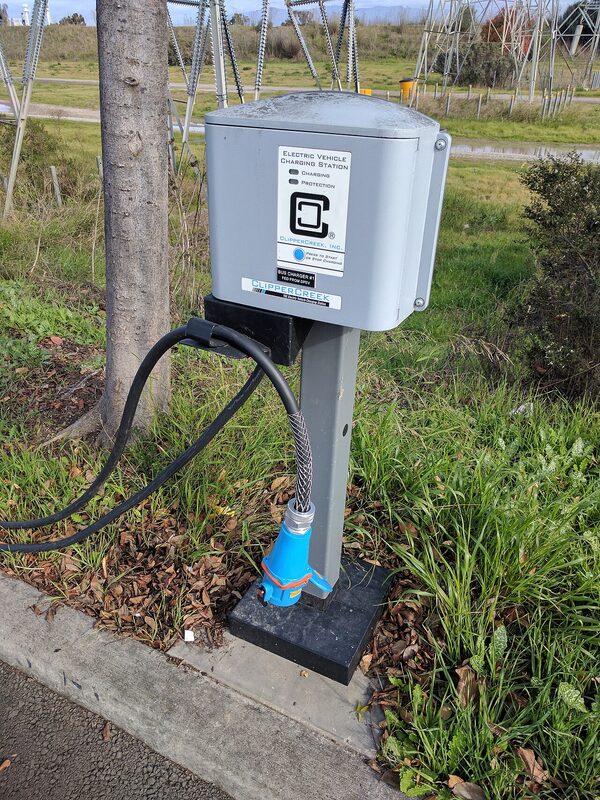
The California Energy Commission (CEC) has published an interim assessment of how well the state's public EV chargers work, and the result is better than most drivers would expect. The report, CEC-600-2026-034, appeared in November 2026 and draws on field tests the CEC commissioned from the UC Davis Electric Vehicle Research Center under Assembly Bill 2061. Testers visited chargers from January 2024 through February 2026. They found 96.2% of Level 2 ports and 96.4% of DC fast charging (DCFC) ports operational at the time of testing.
Payment was the weak point. When testers were assigned a credit or debit card, the first attempt failed more than 34% of the time.
The CEC PDF is dated only "November 2026", with no exact day. EV Infrastructure News covered the report on November 20, 2026.
How the Testing Worked
The report draws on two kinds of data:
- 3,571 plug-in tests, in which a tester physically connected a vehicle and tried to charge. 1,817 of these were at Level 2 ports and 1,754 at DC fast ports.
- Observational data on 12,586 additional ports: 6,635 Level 2 and 5,951 DCFC.
For scale, the CEC cites more than 2.6 million EVs sold in California (cumulative through 2025) and more than 216,000 public and limited-access charging ports installed (through 2025).
The report uses two headline measures, and they answer different questions:
- Operational Rate: was the port working when the tester got there? Level 2: 96.2%. DCFC: 96.4%.
- Successful Charge Attempt Rate (SCAR): could the tester actually start a charging session? Level 2: 93.1%. DCFC: 94.0%.
SCAR is the stricter measure because it counts failed charging sessions at chargers that were otherwise operational. The CEC says these failures are most often due to communication problems between the vehicle and the charger, or to payment system failures. SCAR is calculated from plug-in test data only, while the Operational Rate also draws on observational data, so the roughly 2.4 to 3.1 percentage point gap between the two figures (DCFC and Level 2) is only a rough indication of chargers that looked fine but did not deliver a session.
Payment Method Made a Big Difference
The CEC says the type and number of payment methods at a charger, and which one the driver uses, can greatly affect whether a charging attempt succeeds. Testers were assigned a payment method for each plug-in test, and the CEC measured the first attempt:
| Payment method | First-attempt failure rate |
|---|---|
| Credit/debit card | 34.4% |
| App, membership card or QR code | 14.0% |
| Plug-in payment (Plug & Charge, Tesla, Autocharge) | 2.3% |
Plug-in payment is initiated by connecting the charging port to the vehicle. In these tests it failed about one-fifteenth as often as cards (34.4 divided by 2.3 is about 15). Apps, membership cards and QR codes fell in between.
Two caveats from the CEC matter. First, most plug-in payment tests involved a single large network using that network's own vehicles, so the 2.3% figure may not hold across networks and vehicle types. Second, many first-attempt failures were followed by a successful charge after the tester switched to another payment method. Within cards, tap was more reliable than chip or swipe. The CEC calls the reasons for the card gap worth further study and lists possible explanations: weather-related failures, poor software integration with payment terminals, and weaker cellular or other connectivity on the terminals.
Bigger Networks Scored Higher
The CEC also compared the largest network provider in each charger class with the average of all the others:
- Level 2: the largest network was 2 points higher on operational rate and 11 points higher on SCAR.
- DCFC: the largest network was 7.5 points higher on operational rate and 8.5 points higher on SCAR.
The CEC report summarizes these comparisons without naming the networks, so this article does not name them either. The largest providers raised the statewide averages, and the CEC says the variance among networks shows room for improvement for lower-performing ones.
Location Made Little Difference
One finding is relevant to equity goals. For both Operational Rate and SCAR, results differed by roughly one percentage point or less between rural and urban areas, and between disadvantaged or low-income communities (DAC/LIC) and other communities. The CEC says the differences in Operational Rate between community types are not statistically significant.
Is the Network Really Getting Better?
The CEC says California's network "may have measurably improved" compared with earlier studies. It also notes that those studies used different methods.
One earlier study, by Rempel and colleagues and posted to arXiv in 2022, evaluated 657 CCS connectors at all 181 open public DC fast charging stations in the Greater Bay Area. Only 72.5% were functional, and the cable was too short to reach the vehicle's inlet for 4.9%. The non-functioning units had unresponsive or unavailable screens, payment system failures, charge initiation failures, network failures or broken connectors. The authors said this conflicted with the 95 to 98% uptime reported by the charging service providers, and they called for shared, precise definitions of reliability and uptime. The CEC describes this as the first empirical study it knows of that examined a significant number of EV chargers.
According to the CEC, earlier studies found DCFC charge-attempt success rates between 77% and 86%. The new report puts DCFC SCAR at 94.0%.
The caveat matters. A study of one metro area and a statewide program with structured plug-in tests are measuring different things, and the CEC itself says apples-to-apples comparison across studies is difficult. The CEC's own wording is careful, and the difference between "may have measurably improved" and "has improved" is real.
Why This Report Is Labeled Interim
AB 2061 (Ting, Chapter 345, Statutes of 2022) directs the CEC to develop uptime recordkeeping and reporting standards for publicly funded EV chargers. Beginning January 1, 2025, it also directs the CEC to assess the uptime of EV charging infrastructure and update that assessment every two years. According to the report, the continuous charger data needed to calculate uptime is not yet available. That makes this edition a snapshot of operability at the time of each field test, not a record of uptime over time, and the CEC says it does not determine the formal Uptime metric.
The CEC adopted its EV Charger Data and Reliability Standards regulations in October 2025, and they took effect April 1, 2026. Initial uptime data from publicly funded charging installations is expected at the end of 2026, and CEC staff plan to begin collecting time-series data in late 2026. Those data will support the first official uptime assessment. They do not change the results of this round.
What It Means for Drivers
The tests point to these practical takeaways for anyone charging in public in California:
- Most chargers work. About 96 in 100 Level 2 and DC fast ports were operational when tested. About 93 to 94 in 100 attempts produced a charging session.
- Have a backup payment method. Cards failed on more than a third of first attempts (34.4%). Apps, membership cards and QR codes failed 14.0% of the time. Plug-in payment failed 2.3% of the time, though mostly in tests on a single network. In most cases testers eventually got a payment method to work, but the CEC notes this is a burden for drivers who may not have access to every payment type. Where you pay by card, the CEC found tap more reliable than chip or swipe.
- Location matters less than expected. Results in rural and urban areas, and in disadvantaged communities and others, were within roughly one percentage point of each other.
- The network you use matters. The largest network in each class outperformed the average of the others, by up to 11 points on charge-attempt success at Level 2.
- Nothing changes at the plug right now. This report measures the network and does not create new rules. Later reports are expected to use continuous uptime data and should give a clearer picture of reliability over time.
Site hosts and fleet operators considering charger installations should rely on a licensed electrician and the equipment manufacturer's instructions. The state's uptime reporting standards apply to publicly funded chargers.
Sources
- California Energy Commission, "Results of Field Tests of California's Electric Vehicle Charging Network Conducted Under Assembly Bill 2061" (CEC-600-2026-034, November 2026)
- EV Infrastructure News, "Californian public EV charging points are 'measurably improved,' says CEC" (Nov 20, 2026)
- Rempel et al., "Reliability of Open Public Electric Vehicle Direct Current Fast Chargers" (arXiv)
