
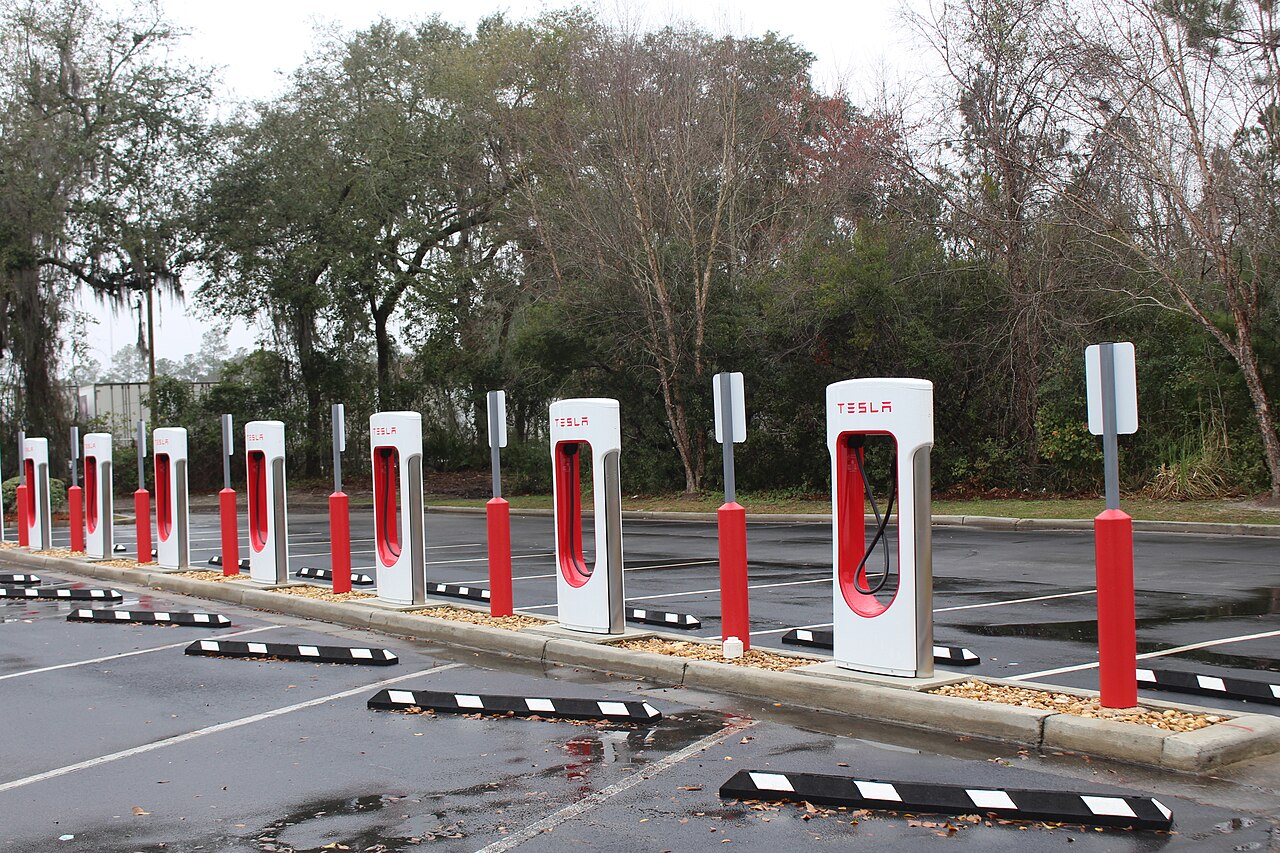
Tesla has opened an eight-stall V4 Supercharger at Penny Faire Plaza on South Cloverdale Boulevard in Cloverdale, Calif. What makes this site different is how it connects to the grid. Tesla says the site is a PG&E Flex Connect site, "talking to the grid over IEEE 2030.5 to open faster," Not a Tesla App reported on Nov. 17, 2026. In practice, the station does not get a fixed, guaranteed amount of grid capacity. According to PG&E's pilot overview, the utility sends an hourly power limit forecast a day in advance, and the site's chargers adjust to it.
For drivers it works like any other Supercharger: eight stalls, rated up to 500 kW per stall, open 24/7. Non-Tesla EVs can use it with a NACS adapter. The difference is on the utility side, and it explains how the site could open before grid upgrades in the area are finished.
The Site at a Glance
- Location: Penny Faire Plaza, South Cloverdale Boulevard, Cloverdale, CA (Not a Tesla App)
- Status: Open. Not a Tesla App, in a report dated Nov. 17, 2026, says the site opened on Monday (Nov. 16, 2026)
- Hardware: eight V4 stalls, up to 500 kW each
- Hours: 24/7
- Access: Tesla vehicles, plus non-Tesla EVs with a NACS adapter
- Grid arrangement: PG&E Flex Connect, with communication over the IEEE 2030.5 protocol
- Not disclosed: the site's actual power limits, or how often they fall below full output
How Flex Connect Works
A large new load such as a DC fast-charging site normally gets grid service in one of two ways. Either the local grid can already handle the full requested capacity, or the site waits for utility upgrades, which Not a Tesla App says can take years, or opens with a permanently lower power limit. Flex Connect offers another option. According to PG&E's pilot overview, customers with controllable loads can connect without waiting for a capacity upgrade. PG&E's grid management system uses the internet to connect to the site's energy management system and sends an hourly power limit forecast one day in advance. The EV chargers then automatically adjust their consumption.
Across eight stalls, that means total site output can be held below what all the chargers could draw at once during hours when the grid is constrained.
PG&E's own example shows what is at stake. In the pilot document, a customer requests 2 MW for EV DC fast chargers. The grid could serve the full 2 MW most of the year, but the customer was limited to 0.5 MW year-round because of a small number of peak hours, and under the normal path would stay at 0.5 MW until upgrades were completed over several years. With Flex Connect, PG&E says, the customer can receive the full 2 MW right away, most of the time. That example is PG&E's illustration, not Cloverdale's numbers. Neither Tesla nor PG&E has published the Cloverdale site's capacity or its hourly limits in the sources reviewed here.
Who Qualifies
PG&E's overview lists four eligibility criteria for customer sites, which are subject to site-by-site analysis:
- The site is in PG&E's service area.
- Customer upgrades are needed, or an existing limit is affecting site operation.
- The customer can modify its power consumption and has an energy management system that can communicate with PG&E's grid management system.
- PG&E has indicated that power capacity upgrades will take longer than 12 months.
The document says the offerings are funded by California utility customers and administered by PG&E under the auspices of the California Public Utilities Commission. Not a Tesla App summarizes the same tests: sites must be in PG&E territory, able to adjust their power use, and facing grid upgrades that would take longer than 12 months.
How the Pilot Has Performed So Far
The most detailed public figures come from Utility Dive's Sept. 2, 2026 report on the program, which relies on interviews with PG&E's program manager:
- Capacity delivered: in the pilot's first two years, participating customers were able to tap the distribution grid for their needed capacity in 90% of hours.
- Operational impact: active participants saw operational loads impacted less than 1% of the time, during what PG&E's manager called "the rare confluence of events" when the local grid is constrained and the customer's demand remains high.
- Participation (as of Sept. 2026): five current Flex Connect customers and roughly 85 prospective ones, most of them in EV charging.
- Typical site size: most active and potential sites range from 2 MW to 5 MW.
- Timeline: a fact sheet for EV fast-charging customers describes a six-step process lasting roughly four to eight months, compared with one- to three-year waits for firm interconnection at full requested capacity before Flex Connect, according to PG&E's program manager.
- Graduations: two customers have so far "graduated" out of the pilot after an average wait of about 18 months.
The two headline numbers measure different things. The 90% figure counts hours in which customers could draw the capacity they needed. The under-1% figure counts how often operational loads were affected. Utility Dive's report does not break either number out by site, and it was published before the Cloverdale site opened, so neither figure describes Cloverdale.
Why a Grid-Limited Site Can Still Make Sense for Chargers
A charging site rarely runs every stall at full power at the same time. Cars arrive at different states of charge, and charging power falls as batteries fill. A cap on total site power below the sum of the stall ratings may therefore matter only during the busiest hours, if those busy hours also coincide with grid constraints. This is the reasoning behind PG&E's "full 2 MW most of the time" example. Whether it holds at Cloverdale depends on figures that have not been released, including the site's limits and its traffic patterns.
What It Means for Drivers
As of Nov. 17, 2026, Not a Tesla App reports that Tesla drivers, and owners of other EVs who have a NACS adapter, can charge at the eight Cloverdale stalls around the clock. The site sits at Penny Faire Plaza on South Cloverdale Boulevard, and the report notes restrooms and food nearby. The stalls are rated up to 500 kW, but the real charging speed depends on the vehicle, its battery state, and how many other cars are plugged in. At a Flex Connect site it can also depend on that hour's PG&E power limit. During a constrained hour with several stalls in use, per-car power could be lower than at a site with the same hardware and full grid capacity. Neither Tesla nor PG&E has said how often that will happen at this site.
None of the sources cited here gives pricing for Cloverdale. Drivers should check the per-kWh rate shown in the Tesla app or on the in-car display at the time they charge. Non-Tesla drivers should also confirm that their vehicle and adapter are compatible before relying on the site for a trip.
The bigger implication is timing. If programs like Flex Connect let sites open while grid upgrades are still under way, some chargers may open months or years sooner than they otherwise would. Utility Dive's figures (roughly four to eight months versus one to three years) describe that gap for PG&E's pilot only. They do not apply to other utilities.
Network Context
Not a Tesla App reported on Nov. 17, 2026 that Tesla had recently passed 85,000 Supercharger stalls at 9,000 locations worldwide, and that grid capacity is often one of the biggest delays for new sites. The same report described Tesla's pre-assembled "Accordion" Superchargers, which fit 16 stalls on one truck and are about 20% cheaper to install, according to that report. It concluded that faster grid connections and faster buildouts could mean more sites like Cloverdale across PG&E's service areas, which is the outlet's expectation rather than an announced plan.
What We Don't Know Yet
- Cloverdale's requested capacity and the hourly limits PG&E has assigned to it.
- How often, and in which seasons or hours, the site will run below full output.
- When, or whether, PG&E's grid upgrades for the area will be finished, and whether the site will then leave the flexible arrangement.
- Pricing at the site. Check the Tesla app.
