
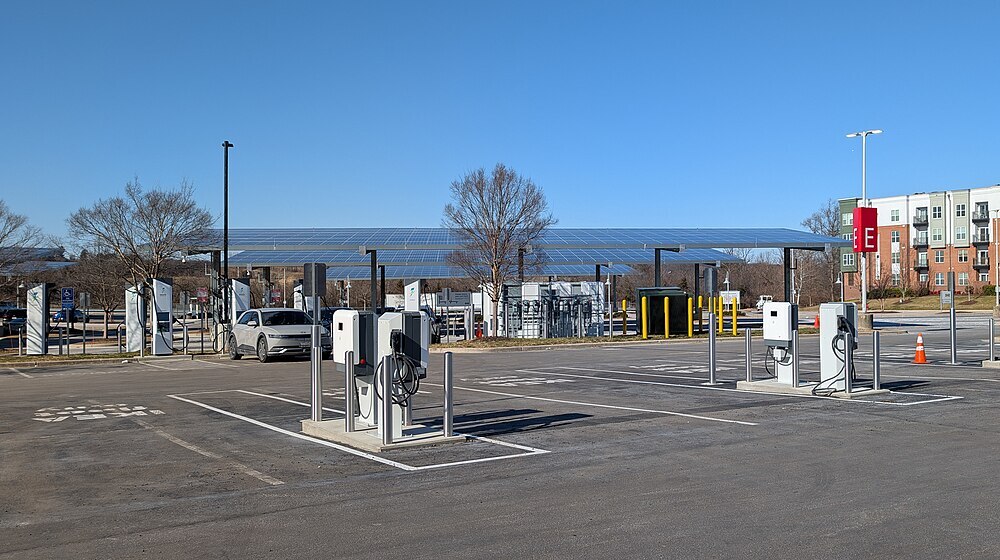
Mercedes-Benz High-Power Charging, the automaker's North American fast-charging network, has reached 100 locations and 934 charging ports. That is three years after its first station opened in November 2023. The figures come from the network's own three-year report, published on November 10, 2026. The company also reports more than 1,000,000 charging sessions since launch, about 205 megawatts of installed charging capacity, and more than 245,000 customers. Its sites are spread across 28 US states and British Columbia.
The milestone came about a week after Mercedes sold its 47 European charging hubs to Electra, The Next Web reported. The same report says the US network stays "for the time being," so North America is where the automaker is still running its own branded fast-charging network as of November 2026.
The growth curve, year by year
The company's report breaks down its build-out by year, showing locations and ports for 2023 through 2026. All of these counts come from Mercedes-Benz High-Power Charging. The report's charts do not say how each year's total is defined, so we treat them as the company's own tallies and do not know whether announced or under-construction sites are included.
| Year | Locations | Ports | Ports per location (calculated) |
|---|---|---|---|
| 2023 | 5 | 32 | 6.4 |
| 2024 | 19 | 188 | 9.9 |
| 2025 | 63 | 597 | 9.5 |
| 2026 | 100 | 934 | 9.3 |
A few things stand out. The biggest single-year jump was from 2024 to 2025, when the network added 44 locations and 409 ports. Growth slowed in the most recent year, to 37 new locations and 337 new ports. Even so, that was about 59% more locations and 56% more ports than a year earlier. After the small pilot-scale first year, average site size has stayed fairly steady at between nine and ten ports per location, by our calculation. According to The Next Web, the network's largest site is in Orlando, Florida, with 20 stalls.
Dividing the roughly 205 MW of installed capacity by 934 ports gives an average of about 220 kW per port. That is our own rough calculation, not a figure the company published. It does not mean every car will charge at that rate: delivered power depends on the vehicle, the battery's state of charge, and how power is shared at each site. The Next Web reports that the network's chargers deliver up to 400 kW.
Reliability is the metric the company leads with
Mercedes' report calls first-time success, defined as a charge that starts on the first attempt, the network's "guiding star." That means how often a driver plugs in and starts a session on the first try, without a second attempt. Per The Next Web, the network's first-attempt success rate rose from about 84% in 2023 to more than 90%.
That focus matches the main complaint about public fast charging in North America, which is reliability. Drive Tesla Canada notes that Mercedes-Benz placed in the top three of J.D. Power's 2026 public charging rankings, along with IONNA and Rivian Adventure Network, ending Tesla's three-year run at the top. All three are relatively new networks.
A note on the session count
Published session totals vary. The Next Web cites more than 550,000 sessions. Mercedes' own three-year report gives more than 1,000,000 sessions since November 2023, as does Drive Tesla Canada. ChargerFeed uses the company's figure because it comes straight from the operator. The gap may be due to different reporting dates or definitions, but none of the sources explains it.
Hardware and connectors
According to Drive Tesla Canada, Mercedes says it was the first network to put 400 kW charging across its entire footprint, and that its stalls are Alpitronic units. According to the company's report, native NACS (SAE J3400) cables are currently available at 93% of its Alpitronic stalls. NACS is the connector Tesla developed and many automakers have since adopted for North American vehicles. A native cable means a NACS-equipped car can plug in directly, with no adapter. The report's chart labels the remaining 7% as CCS only.
Where this fits in the wider market
The network grew during a broader expansion of fast charging. Drive Tesla Canada reports that the number of public DC fast-charging ports in the US and Canada rose 102% between 2023 and September 2026, compared with 73% growth in stations. Mercedes went from 32 ports to 934 over roughly the same period, so it grew much faster than the market overall. It is still a small share of the total, though: the company's report puts the US and Canada total at 85,375 public DC fast-charging ports in 2026, so 934 ports is roughly 1%.
The European sale to Electra makes the strategy clearer. In Europe, Mercedes handed its hubs to a dedicated charging operator, which The Next Web, citing Electrive, says the carmaker called outside its core business. In North America, it is still running its own sites, and in its three-year report it presents that network as a reliability-focused service. The sources reviewed for this article do not include any Mercedes announcements about future North American site counts, funding or timelines. Nothing here should be read as a planned or committed expansion target.
What It Means for Drivers
Where you can charge: As of November 2026, the network lists 100 locations in 28 US states and British Columbia, with 934 ports in total. Sites average a little over nine ports each, and the largest, in Orlando, has 20 stalls (per The Next Web).
Plugging in: The company says native NACS cables are available at 93% of its Alpitronic stalls. Owners of NACS-port vehicles should be able to plug in directly at most stalls. Because the report does not identify the remaining stalls, it is worth checking the connector at a specific site before relying on it.
What it costs: The Next Web reported in November 2026 that charging on the network costs $0.35 to $0.60 per kWh, depending on the site. Prices vary by location and can change, so check the rate shown at the charger or in the network's app before you start a session. The sources do not describe idle fees, membership tiers or time-of-day pricing.
Reliability: The Next Web reports that the network's first-attempt success rate rose from about 84% in 2023 to more than 90%. Its top-three placement in J.D. Power's 2026 rankings points the same way. Your own experience will still vary from site to site.
In Europe: Drivers who used Mercedes' European hubs should note that the 47 sites have been sold to Electra, The Next Web reported. Pricing and access there would follow the new operator's terms, which the sources here do not cover.
Site hosts and fleets: The report does not describe host partnerships, fleet programs or installation terms. For any on-site charging hardware, work with a licensed electrician and follow the manufacturer's instructions.
