
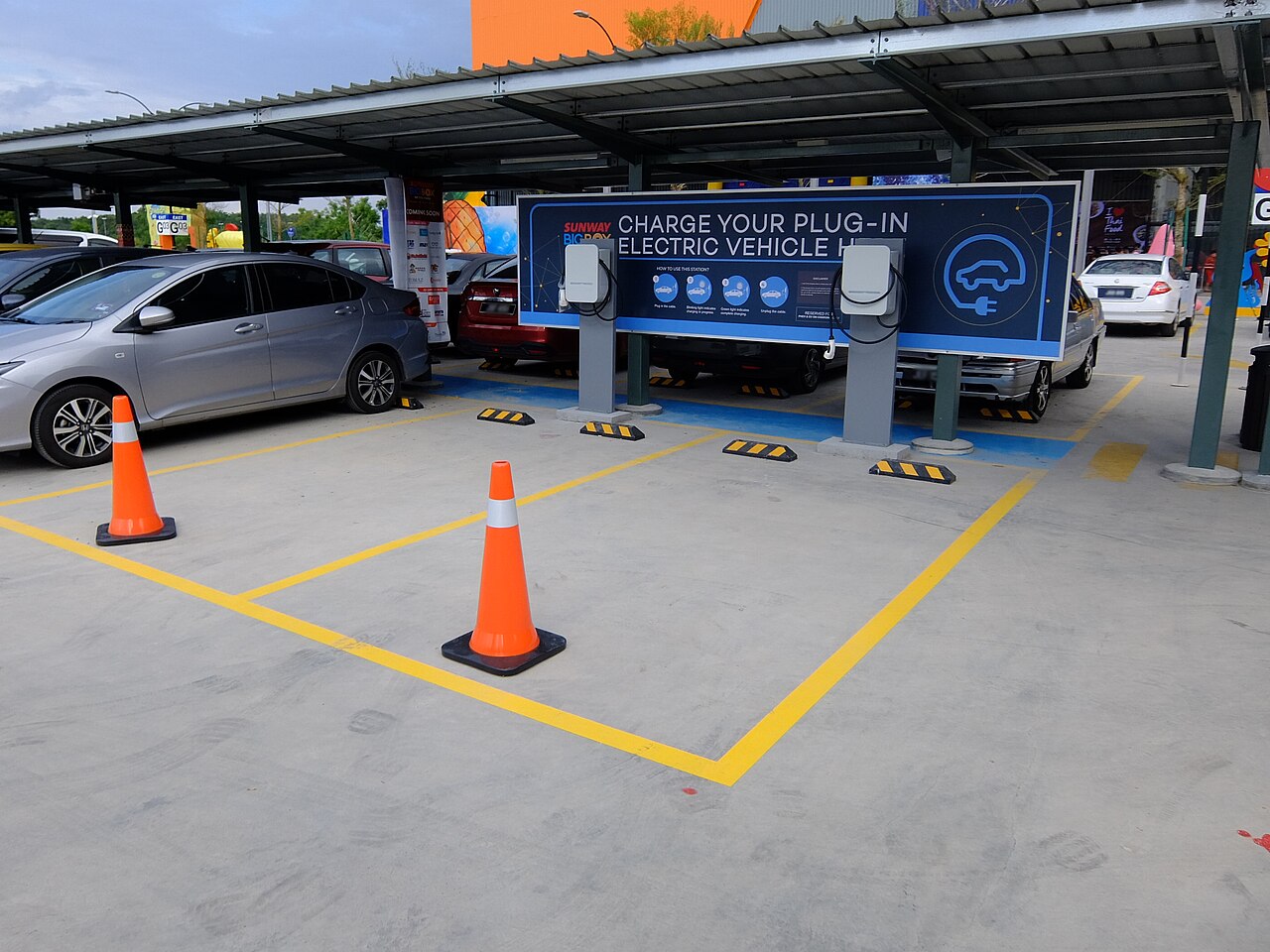
Malaysia has not yet decided whether to put a levy on electric vehicles to pay for more public chargers. The idea is still being studied. That was the answer Deputy Minister of Investment, Trade and Industry Sim Tze Tzin gave in the Dewan Rakyat on Nov. 16, 2026, according to a Bernama report published by Malay Mail. He presented the levy as one of several approaches the government is looking at to speed up the charging rollout toward its target of 30,000 public charging points by 2030.
Sim also gave an updated count of the network. As of Sept. 30, 2026, Malaysia had 7,341 public charging points. Of these, 4,992 were AC and 2,349 were DC fast chargers. He said 148 DC chargers were operating at rest-and-recreation (R&R) areas, lay-bys and petrol stations on major highways, and that 20 charge point operators were active in installing the infrastructure.
Below is a breakdown of what was said, what has been decided, and what is still open.
The Numbers, as of Sept. 30, 2026
- Total public charging points: 7,341
- AC points: 4,992 (about 68% of the total)
- DC fast points: 2,349 (about 32% of the total)
- DC chargers at R&Rs, lay-bys and petrol stations on major highways: 148
- Active charge point operators: 20
- 2030 target: 30,000 public charging points
The percentages, and the gap figures below, are ChargerFeed's own arithmetic from the reported counts. To reach 30,000 points, Malaysia would need about 22,659 more public points than it had at the end of September. That is roughly four times the current network. Spread evenly over the time left before the end of 2030, it works out to a little over 5,000 new public points a year. The Bernama report did not give a year-by-year installation schedule, and it did not say how the target splits between AC and DC.
The 148 highway DC chargers make up only a small part of the 2,349 DC total. Most of the country's DC fast chargers are therefore at sites other than the highway R&Rs, lay-bys and petrol stations Sim listed. The report did not break down the rest by location type.
Is There an EV Levy?
No, not yet. In Parliament, Sim said the levy proposal is still being studied and the government needs to examine various aspects before deciding to implement anything.
The idea first came up in August. On Aug. 4, 2026, The Vibes reported that MITI Minister Johari Abdul Ghani told the Dewan Negara that every EV sold here could be charged a fee to be placed into a fund to build public chargers. The next day, Bernama reported that Johari said the government had not decided to impose the proposed levy and was still looking at the most appropriate mechanism. He also pointed out that if the costs were imposed on manufacturers, they would ultimately pass them on to consumers.
The sources do not give a proposed amount, a rate, a start date or a collection method. Johari himself posed the open questions as at what level the charges should be set and how much they would amount to. Any answer would be a new announcement, and none has been made so far.
Why the Government Is Looking for a Funding Mechanism
The ministers raised two constraints.
Fiscal room. According to Bernama's Aug. 5 report, Johari said the government is operating under a fiscal deficit and cannot rely solely on vehicle manufacturers or distributors to fund public charging stations, and that the government has a constraint in financing a nationwide public charging network on the scale seen in China. A dedicated fund paid for by EV sales is one option he raised, though no such fund has been approved.
Grid connections. In the Nov. 16 session, Sim said one area needing attention is expanding the capacity of electricity substations, in collaboration with the national utility Tenaga Nasional Berhad (TNB). Bernama quoted him saying, "Without substations, expansion will not be possible," and "Substations are expensive, and TNB needs to plan accordingly." He added that a substation cannot be requested today and be ready tomorrow, because it requires construction and planning.
Sim also said the government encourages private sector participation without making it mandatory for operators to install chargers at specific locations, and that there must be enough consumer demand to justify the investment costs. In practice, as the report describes it, the private operators decide where new public chargers go, and the government is not requiring specific sites.
Related Changes on the Vehicle Side
The Vibes' August report also covered the tax treatment of imported EVs. Johari said the government does not intend to extend the full import tax exemption for completely built-up (CBU) EVs after the four-year incentive period, which resulted in an estimated RM3.3 billion in foregone tax revenue. He said public charging infrastructure development by industry players had also not met government expectations. Incentives for locally assembled (CKD) EVs will continue until Dec. 31, 2027, subject to conditions set by the government. These measures affect vehicle prices, not chargers directly, but they are part of the same policy discussion about how much public money goes into EV adoption and where it goes.
In the same report, Johari contrasted EV charging with the roughly 3,500 petrol stations supporting combustion-engine vehicles nationwide. Petrol stations along major highways are also among the sites where DC chargers are operating, according to Sim's Nov. 16 remarks.
What It Means for Drivers
Where you can charge today. As of Sept. 30, 2026, drivers in Malaysia had 7,341 public charging points, with 20 operators active in installing them. About two-thirds are AC chargers, which are slower and generally suit longer stops. The 2,349 DC fast points are the ones that matter for quick top-ups and longer trips. For highway driving, the figure to watch is 148: the number of DC chargers Sim said were operating at R&Rs, lay-bys and petrol stations on major highways.
Nothing changes at the plug yet. No levy has been imposed. The sources give no levy amount and no date, and the government has said it has not decided. None of the sources reported any per-kWh or per-minute charging rates. Check the operator's app or the charger itself for current pricing.
If a levy does arrive. As Johari described it in August, the proposal is a fee on every EV sold, put into a fund to build public chargers. He said that if costs were imposed on manufacturers, they would ultimately be passed on to consumers. On that description, the effect would be on vehicle purchase costs rather than on charging sessions, though no design has been announced.
Where new chargers may appear. Since the government is not requiring specific locations and says demand must justify investment, new public chargers are likely to follow where operators expect enough use. Expansion also depends on substation capacity, which Sim said must be worked out with TNB. The 30,000-point figure is a target for 2030. The sources do not describe it as a funded build program.
What to Watch
- Whether MITI announces a decision on the levy, and if so, the amount, who pays it (manufacturers or buyers), and how the money would be spent.
- The next official count of public charging points, and how the AC/DC split changes as the network grows.
- Any new arrangements with TNB on substation capacity for charging sites.
- Growth in highway DC charging beyond the 148 chargers reported at R&Rs, lay-bys and petrol stations.
Note on sourcing: ChargerFeed did not read a Malaysian government release or Hansard transcript for this article. The Nov. 16 figures come from a Bernama report published by Malay Mail. The August background comes from The Vibes and Bernama.
Sources
- EV levy among options being considered to speed up charging network rollout, says Miti (Malay Mail / Bernama, Nov. 16, 2026)
- Govt considers EV levy to fund nationwide public charging network expansion (The Vibes, Aug. 4, 2026)
- Govt Balancing EV Charging Infrastructure Needs With Public Interest - MITI (Bernama, Aug. 5, 2026)
