
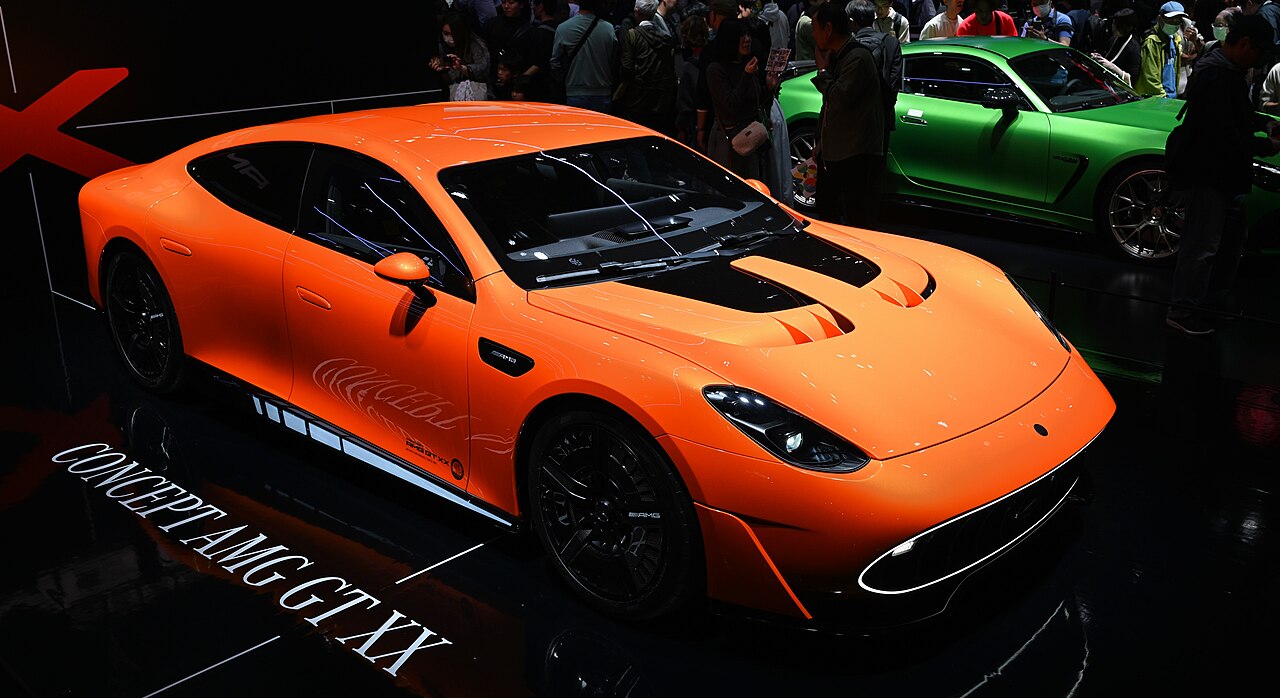
Mercedes-AMG has put a new peak number on the DC charging spec sheet. The company's electric GT SUV, revealed in coverage dated Oct. 17, 2026, is rated for up to 710 kW of DC fast-charging power in its 128 kWh (usable) versions. Mercedes also says the vehicle is designed to support five different DC fast-charging standards, one for each major regional market. The Mercedes-Benz USA newsroom is the source for both claims.
Every charging figure in this story comes from the manufacturer. None has been independently tested. The 710 kW peak also depends on charging hardware well beyond the 350 kW units common today, a point The Beep made in its Oct. 18 coverage for Australian highways.
The numbers, by version
According to Electrek, the US lineup will have three versions:
- GT 63: 1,153 hp, 128 kWh usable 800-volt pack
- GT 55: 805 hp, 128 kWh usable 800-volt pack
- GT 53: 536 hp, 106 kWh pack
Mercedes-Benz USA gives the following charging figures:
- Peak DC power: up to 710 kW for the 128 kWh versions and up to 600 kW for the GT 53 with the 106 kWh pack. Mercedes says 710 kW DC fast charging is possible at 800-volt charging stations, depending on the battery variant.
- 10-80% state of charge: 12 minutes on a capable charger, per Mercedes-Benz USA. Electrek reports 12 minutes for the big-battery versions and 11 minutes for the GT 53.
- Range added in 10 minutes: up to 450 km (WLTP) for the 128 kWh versions and up to 380 km for the GT 53 at up to 600 kW. Electrek gives the 128 kWh figure as 454 km (282 miles) WLTP, matching the 454 km in Mercedes's spec table; the 450 km headline figure is the rounded "up to" number.
- At a 400 kW station: 14 minutes for the GT 53 (106 kWh) and 16 minutes for the GT 63 and GT 55 (128 kWh), per Mercedes-Benz USA.
- AC charging: 11 kW (also given by The Beep).
Mercedes says the recharged-range figures were determined using maximum DC charging power in accordance with ISO/SAE 12906. Range-added figures are WLTP-based, which is a European test cycle. Electrek notes to expect lower EPA numbers; no EPA figures appear in the sources.
The Beep's Australian report describes the configurations a little differently. Its table lists the GT 55 and GT 63 with either the 106 kWh pack (600 kW) or the 128 kWh pack (710 kW), and it states that the 710 kW peak applies only to the larger 128 kWh battery. Electrek's US lineup pairs both the GT 63 and GT 55 with the 128 kWh pack. Buyers should check the battery on any specific trim before assuming the higher figure applies. The Beep also gives WLTP range with the 128 kWh pack as 620 km.
Why the 400 kW figure is the more useful one
The headline 710 kW number needs a charger that can deliver it at 800 volts. The Beep notes that owners would need chargers well beyond the 350 kW units common on Australian highways to see that rate. Electrek says most of the fastest public chargers in the US, such as those IONNA is rolling out, are rated for 400 kW, and that there is almost nowhere to charge at 710 kW today.
That makes Mercedes's 400 kW station figures the more practical reference: 14 to 16 minutes, depending on battery. Mercedes does not pair the 400 kW times with the same wording as the 10-80% figure in the passages read, so a like-for-like comparison is an assumption. If both are 10-80% sessions, moving from a 400 kW station to a 710 kW-capable one would save about four minutes for the 128 kWh versions (16 minutes versus 12).
Five plugs, one platform
From a standards perspective, the more unusual claim is connector coverage. Mercedes-Benz USA says the GT SUV is designed to support five DC fast-charging standards, each tied to a market:
- NACS for the United States
- CCS2 for Europe
- GB/T for China
- CHAdeMO for Japan
- CCS1 for South Korea
As the sources describe it, this is a global design intended to support each region's standard. It does not mean that a single car has five ports. The sources do not say whether a US car ships with adapters for other connector types, so drivers should not assume it does.
Mercedes also says the system automatically switches from 800-volt to 400-volt mode for charging at 400-volt stations. This matters because a large share of installed DC hardware operates in the 400-volt class. The sources did not give a charging-power figure for 400-volt stations.
Battery chemistry
Electrek reports that the pack uses tall, narrow cylindrical cells with an NCMA (nickel-cobalt-manganese-aluminum) cathode and silicon in the anode, and that Mercedes claims more than 298 Wh/kg at the cell level. Mercedes-Benz USA describes an electrically non-conductive oil flowing directly around each cylindrical cell for cooling and says the battery design enables sustained high power delivery. The sources do not quantify how long the car can hold power near its peak during a session.
What It Means for Drivers
When: Mercedes-Benz USA says the 2028 Mercedes-AMG GT SUV arrives at US dealerships in summer 2027, and Electrek reports the same timing. The car is announced, not on sale in the US, and nothing about its charging performance can be observed in the field yet. The Beep reports that Australian timing is unconfirmed.
Where you can charge: The US version is listed for NACS. Electrek says that means Supercharger access should not be a problem, but that is Electrek's reading; Mercedes-Benz USA's release as read does not name specific networks.
What speed to expect: On a 400 kW station, Mercedes quotes 14 to 16 minutes. On chargers rated below the car's peak, drivers will be limited by the charger, not the car. The 710 kW figure applies only to the 128 kWh pack and only at 800-volt hardware capable of that output. Electrek says there is almost nowhere in the US to charge at 710 kW today.
At home: AC charging is rated at 11 kW. For any home charging equipment, consult a licensed electrician and the equipment manufacturer's instructions.
Price: Electrek says Mercedes has not released US pricing. The Beep reported on Oct. 18, 2026, that the GT 53 starts from EUR 113,050 in Germany. That figure is not a US price and may not reflect US equipment or taxes.
Caveat: All charging times, power ratings and range figures are manufacturer claims, mostly measured on WLTP or ISO/SAE 12906 bases. Independent results on US chargers will not be available until cars reach owners.
