
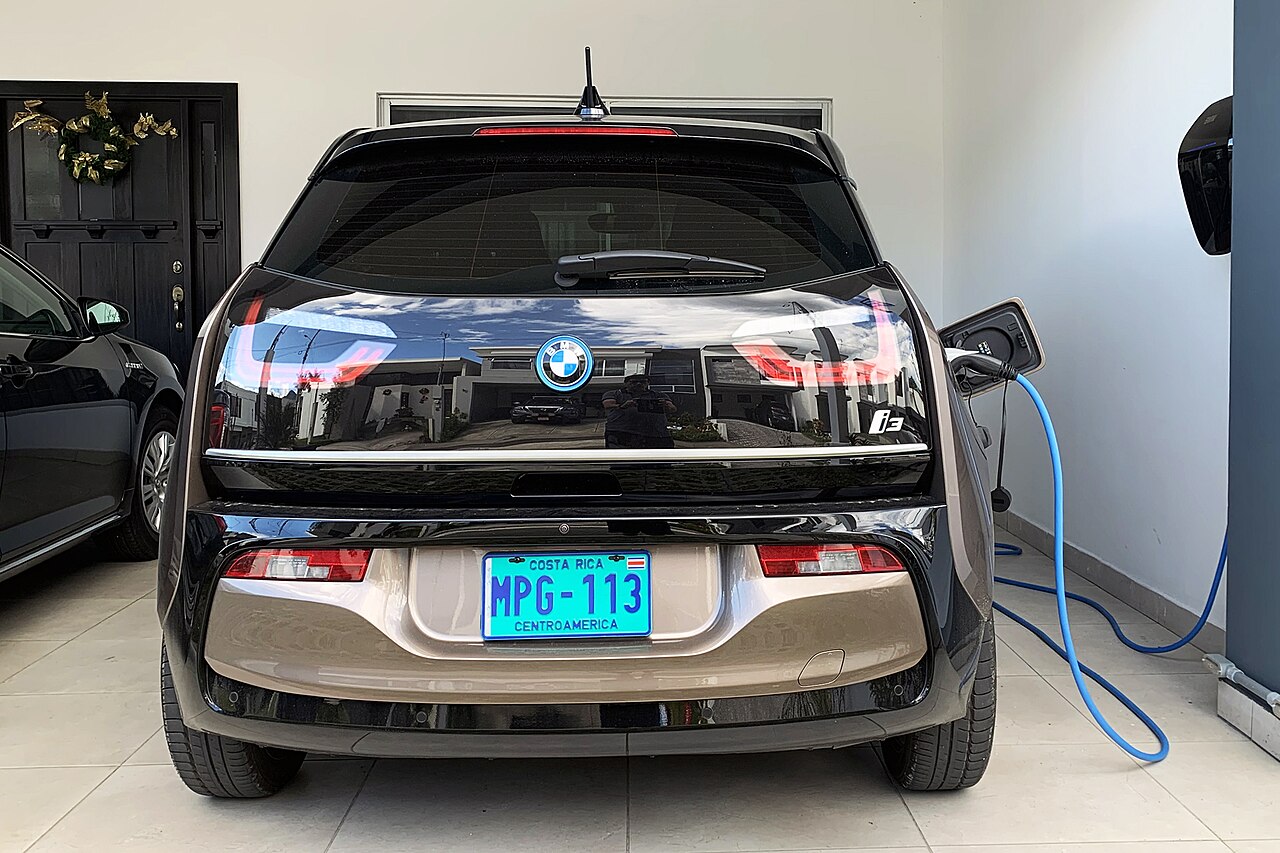
BMW Group and E.ON have opened their German home vehicle-to-grid (V2G) package to more cars. In a release dated Nov. 18, 2026, BMW said the offer is now available for the Gen6 BMW i3, iX4 and iX5 as well as the iX3, which launched the program in February. That makes four eligible models.
The release also gives the current pay rates. Drivers get a bonus of 24 cents for every hour the car is plugged in with V2G active, capped at EUR 60 a month or EUR 720 a year. Each kilowatt-hour the car feeds back to the grid is paid at 42 cents. BMW's release describes the offer in terms of German customers and the German E.ON tariff.
The package, piece by piece
According to BMW's Nov. 18 release, the package has two main parts. One is a bidirectional BMW Wallbox Professional. The other is E.ON's ÖkoStrom Home & Drive V2G electricity tariff, which BMW describes as having a fixed active price and a standing charge. When BMW and E.ON launched the program in February 2026, the IAA Mobility newsroom described the bundle as an 11 kW Wallbox Professional, the Home & Drive V2G tariff with a feed-in contract, and the necessary smart meter.
The driver does not schedule the charging and discharging. BMW says an algorithm developed by BMW and E.ON decides when the car charges and when it sends energy back. The control system takes the desired minimum state of charge into account, according to BMW, and customers can set their charging target in the My BMW app.
BMW's release does not give one all-in price for the wallbox or for the tariff's standing charge. Anyone who wants to work out the net value needs those numbers from BMW and E.ON directly.
The money, in numbers
The program pays in two separate ways, and they are worth keeping apart.
- Connection bonus: 24 cents per hour plugged in with V2G active, up to EUR 60 a month and EUR 720 a year (BMW, Nov. 18, 2026). BMW's release says the bonus is based solely on connected time, regardless of whether charging or discharging actually takes place, and the February IAA Mobility coverage said the same. BMW's footnote puts the monthly maximum at 250 charging hours, which matches our arithmetic: EUR 60 divided by 24 cents is 250 hours, or a little over eight hours a day in a 30-day month. The annual cap of EUR 720 works out to 3,000 hours. The hour counts are ChargerFeed's arithmetic from the published rates.
- Feed-in payment: 42 cents for each kWh sent back to the grid (BMW, Nov. 18, 2026). For example, 100 kWh fed back in a month would earn EUR 42 at that rate.
BMW turns the bonus into a driving figure. It says an i3 driver could travel up to 16,000 km a year free of charge. In a footnote, BMW bases this on an average electricity price of 32.97 cents/kWh, which the bonus would cover up to 2,184 kWh a year, and on WLTP consumption of 13.5 to 16.1 kWh/100 km for the BMW i3 50 xDrive, giving a theoretical range of roughly 13,500 to 16,000 km. At the February launch, IAA Mobility reported that iX3 owners could, in theory, drive up to 14,000 km a year for free. These are manufacturer estimates on a theoretical basis, not guarantees.
A small change in the feed-in rate
The per-kWh rate has gone up since launch. In February 2026, Automotive World reported that each kWh discharged to the grid was paid EUR 0.40. The Nov. 18 BMW release says 42 cents, 2 cents more. Neither source explains the change or says whether it applies to existing customers as well as new ones.
How the program got here
BMW's release sets out this timeline:
- September 2025: E.ON and BMW announced the V2G service at IAA Mobility.
- February 2026: orders opened for the iX3, the first eligible model. According to IAA Mobility and Automotive World, the first eligible cars were Neue Klasse models with sixth-generation (Gen6) eDrive, and the first 100 iX3 customers signing up for the E.ON V2G tariff were offered a EUR 700 discount on the wallbox.
- Summer 2026: the joint project was honoured with the Bavarian Energy Prize, according to BMW.
- Nov. 18, 2026: the offer was extended to the Gen6 i3, iX4 and iX5.
The sources do not say whether the EUR 700 wallbox discount for early iX3 customers was offered again for the newly added models. Readers should not assume it was.
Without a bidirectional car: the smart-charging option
BMW's release also describes a simpler option for owners whose cars are not eligible for V2G. Cost-optimised charging is available for every electrified BMW and MINI model, and an exclusive E.ON partner offer lets BMW and MINI customers in Germany save up to EUR 240 a year through smart charging, according to BMW. BMW's footnote ties the EUR 240 to a night-time charging bonus granted until Dec. 31, 2028, with conditions such as six charging sessions a month. The offer also lists a EUR 50 bonus on top of E.ON's existing new-customer bonus. This option only moves charging to cheaper times. It does not send energy back to the grid, so the V2G feed-in rate and hourly connection bonus do not apply.
What It Means for Drivers
Who can sign up: Customers in Germany with a Gen6 BMW iX3, i3, iX4 or iX5, as of BMW's Nov. 18, 2026 release. Eligibility depends on the vehicle generation, not just the model name. The sources tie V2G to sixth-generation eDrive, so drivers with earlier BMW EVs should not assume their car qualifies.
Where the charging happens: At home, through the bidirectional BMW Wallbox Professional, on E.ON's ÖkoStrom Home & Drive V2G tariff. The February launch description also listed a smart meter as part of the package. The sources do not cover public or workplace V2G.
What changes now: Three more models are eligible, and the published feed-in rate is 42 cents per kWh (BMW, Nov. 18, 2026), compared with the 0.40 EUR Automotive World reported in February 2026. The connection bonus is still capped at EUR 720 a year.
What you control: The charging target, set in the My BMW app. BMW and E.ON's algorithm handles the rest of the charge-and-discharge schedule.
What to check before signing: The wallbox price, the tariff's fixed active price and standing charge, and the contract terms. The BMW release does not list these as single figures. The headline bonus and feed-in rates only show the income side. Whether the package pays off for a given household depends on how many hours the car sits plugged in, how much energy actually flows back, and the costs the release leaves out.
Sources
- BMW Group Newsroom: Bidirectional charging for new BMW models: E.ON and the BMW Group are expanding their V2G offering (Nov. 18, 2026)
- IAA Mobility newsroom: BMW and E.ON Officially Launch Bidirectional V2G Offering in Germany (Feb. 2026)
- Automotive World: BMW and E.ON launch V2G charging offer in Germany (Feb. 2026)
