
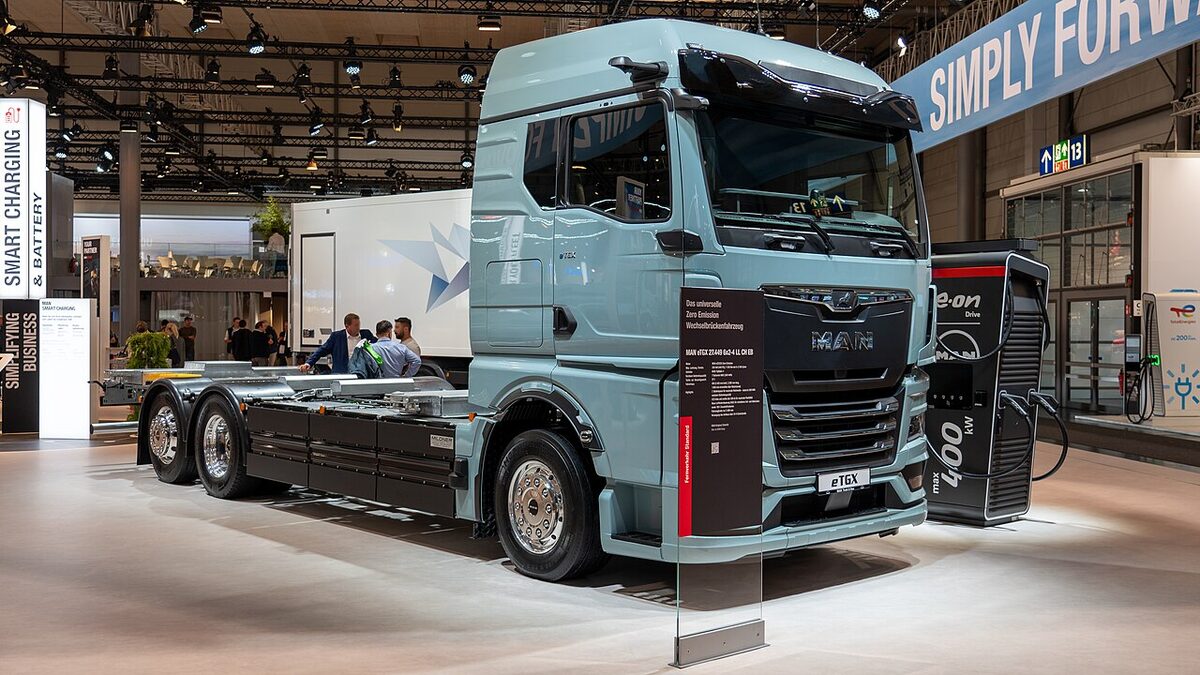
A heavy electric truck parked at a freight forwarder near Regensburg, Germany, has shown it can push power back out of its battery at up to 350 kilowatts. The hardware worked and so did the communication protocol. The open question is the business side: researchers say there are currently no uniform standards for marketing the electricity a truck battery holds.
That is a main finding of SPIRIT-E, a German government-funded research project whose closing results were published by the Technical University of Munich (TUM) in a press release. The project ran from August 2023 to October 2026. TUM led it, with partners MAN Truck & Bus, Fraunhofer IEE, the energy-economics institute FfE, SBRS (Shell), transmission operator TenneT, roaming platform Hubject and Consolinno Energy.
This was a pilot-stage research project. TUM describes the electricity trading as tested in a pilot environment, and the sources describe no commercial service that comes directly out of it.
The numbers
According to TUM's closing press release, the project's test truck had 480 kWh of usable battery capacity. It fed power back "at a power output of up to 350 kilowatts" through a bidirectional DC charging station at a freight forwarding company in the Regensburg area. TUM names the company as Schmid. Automotive World, relaying a MAN Truck & Bus announcement dated April 28, 2026, identifies the truck as a battery-electric MAN eTGX and the site as the logistics firm Spedition Schmid near Regensburg. The project's launch materials list SBRS as responsible for developing the bidirectional charging hardware.
The project tested three bidirectional use cases:
- Vehicle-to-vehicle (V2V): one truck charging another vehicle.
- Vehicle-to-site (V2S): a truck supporting the power supply at the premises it is plugged into.
- Vehicle-to-grid (V2G): a truck feeding power into the public grid.
TUM said that "communication between the vehicle and the charging infrastructure was based on the international standard ISO 15118-20." That is a vehicle-to-charger communication standard.
What the cost modelling found
TUM's accompanying research drew on real-world driving data from six German heavy-duty fleets covering 2.15 million recorded kilometers. The figures below come from TUM's closing release:
- Depot energy costs: the project team estimates that using stored truck electricity at the depot could reduce energy costs by around 10%. TUM says that for a truck running 100,000 km a year, this equals the energy cost of driving 10,000 km.
- Grid and market integration: smart integration with the power grid and electricity market reduced the total costs of the fleets studied by an average of 1.7 euro cents per kilometer. With bidirectional charging, the reduction reached 6.1 cents per kilometer.
- Depot solar plus stationary storage: companies that include solar power and battery storage in their planning can save 25% to 44% more than by converting the trucks alone.
- Time on the road: when electric trucks can reserve public charging points in advance on long-haul routes, the median additional time compared with diesel trucks falls, depending on the scenario, to around 1% to 4%.
MAN uses a wider range. In its own communication about the demonstration, reported by Automotive World, MAN says intelligent energy management can cut electricity costs by 10% to 20%. MAN also describes itself as the first European commercial-vehicle maker to publicly demonstrate bidirectional charging on a heavy-duty truck, and says it expects V2G to become a viable revenue stream for fleet operators by the end of the decade. Those are the manufacturer's own claims and projections. The research consortium's estimate is around 10%.
Why standards are the sticking point
The project's own conclusions are blunt about what still stands in the way. TUM says the biggest hurdles now lie less in technical implementation than in grid integration and the economic framework. It names two examples. First, at many depots the existing grid connection capacity is insufficient to charge larger fleets of electric trucks. Second, there are "no uniform standards for marketing the electricity stored in truck batteries," and many providers use proprietary technical solutions that are incompatible with one another. TUM adds that it remains to be determined how responsibilities and revenues should be divided among freight carriers, vehicle manufacturers and electricity marketers.
That distinction matters. The ISO 15118-20 standard TUM cites concerns communication between the vehicle and the charging infrastructure. Marketing the stored energy is a separate question, and it is the one TUM says lacks uniform standards. SPIRIT-E divided the related work across partners. According to the project's launch release, published by the charging-standards group CharIN in January 2024, Fraunhofer IEE was responsible for the aggregation control system and data exchange, Consolinno for flexibility data aggregation and measurement data, TenneT for system services, and Hubject for roaming, Plug and Charge and a reservation system.
Even at launch, the release said new processes, IT systems and standardized interfaces would have to be defined and developed to integrate new decentralized loads. At the close, TUM's statement says the work of standardizing is still ahead. "The task now is to standardize and scale the solutions that have been tested and turn them into viable business models," said Prof. Markus Lienkamp of TUM.
Background: shared depots and the policy context
SPIRIT-E was about more than bidirectional power. According to IAA Transportation's January 2024 post, one goal was to open private charging at logistics hubs to outside freight carriers, so a depot's chargers could be shared with trucks from other companies. The same post says the project would set up real-world laboratories at two logistics sites to test the approach.
The project was funded by the German federal government for three years. The launch release names the funder as the Federal Ministry for Economic Affairs and Climate Action (BMWK), under its "Begleitforschung Elektro-Mobil" programme, with DLR-PT as project agency. TUM's closing release refers to the Federal Ministry for Economic Affairs and Energy, with the DLR Project Management Agency managing the project. IAA Transportation notes the regulatory backdrop: the European Commission has proposed a 90% cut in CO2 emissions from heavy-duty vehicles by 2040.
What It Means for Drivers
For now, nothing changes at the plug. SPIRIT-E was a research project. Its 350 kW feed-back test ran at one test site, and the sources describe no public or commercial bidirectional truck-charging service based on it.
For truck drivers and fleet dispatchers, the most practical finding is about reservations. TUM's research says that when electric trucks can book public charging points ahead on long-haul routes, the median extra time compared with diesel falls to around 1% to 4%, depending on the scenario. The project developed and tested a reservation system for charging stations, with Hubject named for that role at launch. A reservation service on public truck chargers is something drivers will only see if charge-point operators and roaming platforms roll one out. The sources give no launch date.
For depot operators and site hosts, the takeaway is that bidirectional charging may lower energy costs, by around 10% in the project team's estimate, with more possible when solar and storage are added. TUM notes that how much a carrier saves depends mainly on annual mileage, vehicle downtime and electricity prices. The main limits TUM names are grid connection capacity at depots and the lack of uniform standards for marketing stored energy. Any depot looking at bidirectional or high-power charging should work with its utility, a licensed electrician and the equipment manufacturer's instructions on connection capacity and installation.
For car and van drivers, SPIRIT-E does not change anything directly. The project covered heavy trucks and depot infrastructure only.
Sources
- Electric trucks: Reliable on the road and profitable as energy storage (TUM press release)
- MAN's eTGX feeds the grid in SPIRIT-E demonstration (Automotive World)
- SPIRIT-E: Research Project on Heavy-Duty Electric Truck Charging (IAA Transportation)
- Elektrifizierung des Schwerlastverkehrs: SPIRIT-E entwickelt intelligente und bidirektionale Ladelösungen (CharIN)
