
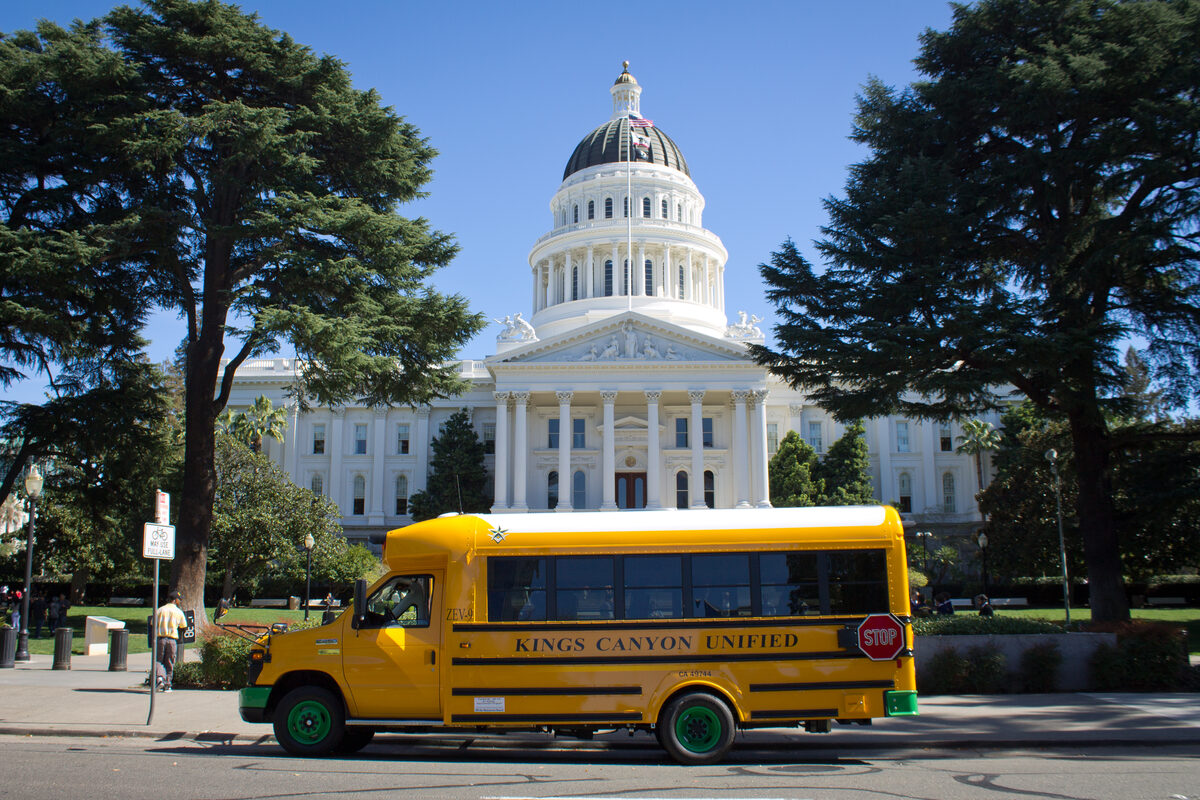
The Oakland Unified School District's 74 electric school buses have returned 1.7 GWh of electricity to the grid over two years, Electrek reported on Oct. 20, 2026, after touring the Irvine, Calif., facility of Tellus Power, the company that builds the fleet's vehicle-to-grid (V2G) chargers, and speaking with Tellus CEO Mike Calise and CTO Srikanth Kanaparthi. The fleet is operated by the student-transportation company Zum, which features Oakland Unified among its customer stories as "a fully electrified fleet."
The fleet in numbers
The Oakland buses hold 11.5 MWh of battery storage combined. They charge overnight, use 20 to 40 percent of their charge on the day's routes, and then discharge to the grid in the late afternoon, leaving most of each battery available for export once the buses are back at the depot.
Plugged into bidirectional chargers, the fleet can discharge about 2 MW at once. Electrek's headline figure of roughly 1,000 homes rests on its own estimate that each house uses about 2 kW on average in the evening; it describes instantaneous output, not a number of homes served continuously.
Over two years, the buses sent 1.7 GWh back to the grid, which Electrek valued at "hundreds of thousands of dollars worth of electricity." The money comes through energy arbitrage, which lets the Oakland school district buy power when it is cheap and sell it when it is expensive. Electrek described the fleet as functioning like "a small and reliable peaker plant."
How reliable is it?
Electrek reported uptime of over 99.5 percent for the Oakland deployment across the two years. Tellus's own website lists a figure for its V2G equipment: "99% uptime across more than two years of continuous V2G field service." Both are claims about a single manufacturer's equipment in its own deployments rather than results from a third-party reliability study.
What makes the hardware different, per Tellus
Tellus has built AC and DC chargers since 2010, with power ratings up to 480 kW. Its V2G chargers are Build America Buy America (BABA) compliant and assembled in the U.S., according to Electrek. The company's website describes "a transformer-free, DC-coupled architecture," and the executives said their chargers don't require large transformers on site, which they said makes deployment faster and cheaper. Tellus also argued that a fleet V2G depot can be deployed in months, compared with years for other kinds of power plants.
On grid interconnection, Tellus's website claims "the first UL 1741-SA certification for V2G grid interconnection in North America." The "first" claim is the company's own.
For context on the company's size, Tellus says it has "450,000+ units deployed across four continents," manufactures at a 30,000-plus-square-foot facility in Irvine, and has more than 100,000 square feet of production capacity across two manufacturing hubs. Its website pitches its heavy-duty depot products as sized to bus and truck duty cycles.
Where else Tellus V2G chargers are in use
Beyond Oakland, Tellus listed several other projects to Electrek, mostly at school-bus depots:
| Location | Scope |
|---|---|
| Oakland, Calif. | 74 school buses, operated by Zum |
| San Francisco, Calif. | 104 school buses, scaling to 238 |
| Burlington, Vt. | 4 school buses |
| Burnaby, B.C. | 2 city-bus chargers for Lynch Bus Lines |
| Illinois | Pilot for ComEd at 3 school-district sites |
In San Francisco, 238 buses is the planned scale rather than the current count, and the Illinois work is a pilot at three sites for the utility ComEd. Looking beyond buses, Tellus told Electrek that electric trash trucks, which have similar duty cycles and could also earn grid-service revenue, are the next direction it would like to go in.
Why school buses suit V2G
The Oakland numbers illustrate the case the executives made: a bus that charges overnight and uses only part of its battery on its routes still has most of its energy available when it returns to the depot in the afternoon. The 11.5 MWh of storage across 74 buses works out to roughly 155 kWh per bus on average.
Electrek's broader argument is that fleets, public or private, can both save on fuel and earn revenue from V2G.
What It Means for Drivers
None of these deployments adds public charging. The Tellus V2G units sit at school-bus and city-bus depots in Oakland, San Francisco, Burlington, Burnaby and the three ComEd pilot sites, and they serve those fleets only; passenger-EV drivers in those areas will not gain stalls from them.
The equipment is also not a home product. Tellus markets these chargers to heavy-duty bus and truck fleets, and the power the Oakland buses export goes to the grid as a whole rather than to particular households.
