
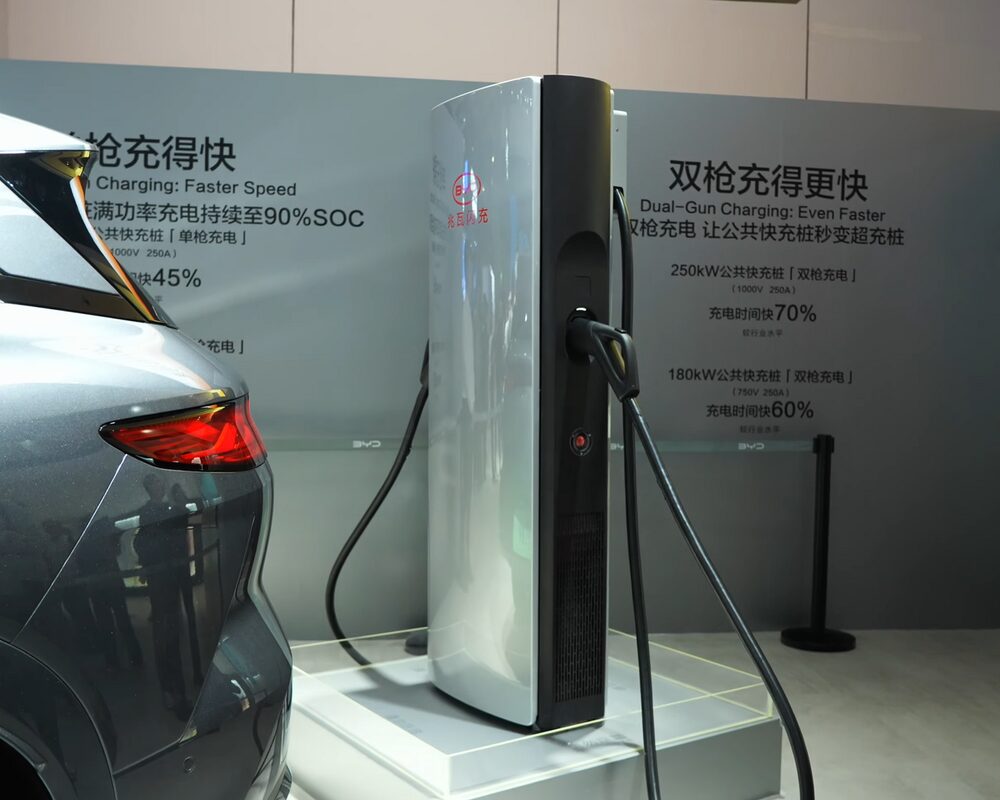
BYD has put a charging installation in the Abu Dhabi desert that combines four things in one system: solar panels, stationary battery storage, the company's FLASH Charging hardware and a robotic arm that plugs the car in so the driver doesn't have to. The company announced it in press releases dated Nov. 9 (French-language global media site) and Nov. 10, 2026 (UK media site). It calls the site the "world's first" to integrate all four.
The headline numbers are BYD's own charging-time claims: 10% to 70% in 5 minutes and 10% to 97% in 9 minutes. Several details matter just as much to anyone planning or using charging sites, and BYD hasn't published them. The releases give no power rating for the site, no charger or stall count, no price and no word on public access. Below is what is confirmed, what is planned and what is still unknown.
What BYD Actually Built
BYD says the site is built on its Solar-Storage-Charging (SSC) system, which connects solar generation, battery storage and FLASH Charging into one setup. According to BYD's release, pairing solar with storage lets the SSC system support operation independent of the electricity grid. BYD says this reduces dependence on existing power infrastructure and allows deployment in locations where grid access is limited.
BYD says the location also demonstrates the system in a climate shaped by intense sunlight, high temperatures and scarce rainfall. Electrek reports that BYD launched the system in the Abu Dhabi desert after unveiling the Yangwang Altior in the UAE on Monday, Nov. 9.
Spanish outlet Motor.es explained the storage logic in plain terms. The station's batteries fill slowly from the grid or from the sun, then discharge quickly when a car arrives, so the site doesn't need a large grid connection. In other words, the stationary battery supplies the high peak power, and the solar array and any grid connection would only need to keep that battery topped up between sessions. That is the outlet's explanation, not a specification BYD has published.
BYD cites the track record of its solar unit, BYD Solar, which it says has more than 16 years of experience in the solar industry, customers in more than 100 countries and regions, an R&D team of more than 300 specialists and more than 200 technology patents.
How the Robotic Arm Works
BYD describes the arm doing three steps without the driver: it automatically locates the charge port, opens the charge-port cover and inserts the connector. It uses visual guidance and force feedback to ensure accurate alignment and a secure connection to the FLASH charging system. Electrek adds that the arm also removes the plug when the session is over.
The arm works together with BYD's Automated Valet Parking. In BYD's description, the driver gets out and locks the car, the car autonomously navigates to a designated charging space, and the arm then connects it. The result is a charging session the driver never physically handles. BYD has not said which models support the valet-parking part of this flow.
The Power Question
BYD has not said how much power the Abu Dhabi site delivers, and readers should treat any specific kilowatt figure with caution. Neither the English release on BYD's UK media site nor the French release on media.byd.com gives a capacity or kW rating for the station.
Motor.es says BYD did not specify the installation's power, though chargers of up to 1,500 kW are being discussed. For comparison, the outlet puts a typical Spanish fast charger at about 150 kW. Motor.es also says those figures are only reached with BYD's second-generation Blade battery. Those are the outlet's statements, not BYD's. Until BYD publishes a rating, ChargerFeed treats figures in the 1,000 to 1,500 kW range as unconfirmed for this site.
The 5-minute and 9-minute times are manufacturer claims, and BYD has not published test conditions such as ambient temperature, starting battery temperature or the vehicle used for the Abu Dhabi demonstration.
Status: Operating Demonstration, Not a Network Opening
Here is how the pieces break down by status, as of Nov. 10, 2026:
- Operating: one integrated solar, storage, FLASH Charging and robotic charging installation in the Abu Dhabi desert, which BYD says demonstrates the system in desert conditions.
- Not disclosed: public access, operating hours, pricing or the number of charging positions at this site. BYD's releases say nothing on these.
- Planned: BYD's releases say the Abu Dhabi site is part of the wider FLASH Charging rollout, and that BYD plans 6,000 FLASH Charging stations worldwide by the end of 2027. Electrek reported the same target. This is a company plan. It is not a count of stations built or funded, and the releases do not break it down by country. Motor.es, citing the brand's information, reads the figure as 6,000 outside China, including 3,000 in Europe; BYD's releases do not state that.
BYD frames the project in terms of Chairman and President Wang Chuanfu's 2006 "Three Green Dreams": harnessing solar power to generate clean energy, storing it in batteries and replacing petrol-powered vehicles with electric ones. Stella Li, BYD Executive Vice President, said in the UK release: "For the first time, BYD is bringing its integrated Solar-Storage-FLASH Charging technology to the global stage."
Why the Off-Grid Angle Matters to Site Hosts
For utilities, state DOT staff and site hosts, the most significant claim is not the charging speed. It is BYD's claim that the SSC system can support operation independent of the grid. A system that buffers power in on-site batteries and refills them from solar could, in principle, lower the size of grid connection a site needs. Motor.es makes that same point, saying the approach opens the door to sites where grid electricity does not reach.
BYD has not published the numbers needed to judge that claim for a given location: storage capacity in kWh, solar array size, how many back-to-back sessions the battery supports before it needs recharging, or how the system performs over several cloudy days. Anyone evaluating a similar setup should get those specifications from the manufacturer. Design and installation work belongs with licensed electricians and engineers, following the manufacturer's instructions and local utility interconnection rules.
What It Means for Drivers
For now, the Abu Dhabi site is a demonstration. BYD has not said the public can charge there, and it has not given prices, hours or the number of charging spaces. Drivers in the UAE or elsewhere shouldn't plan trips around it until BYD publishes access details.
The bigger change for drivers is the robot-plus-valet model, if it spreads. In BYD's description, a driver could leave the car, lock it and walk away, while the vehicle drives itself to a charging space and the arm handles the plug. BYD has not said which vehicles support this or when it might show up beyond this installation.
The 5-minute and 9-minute charging claims are BYD's figures, and BYD has not said which vehicles achieve them. BYD's release lists the 2nd Generation Blade Battery and FLASH Charging together among its recent advances, and Motor.es says the high-power figures need that battery, so drivers of other EVs should not assume they will see the same speeds. As for the wider network, BYD's stated plan is 6,000 FLASH Charging stations worldwide by the end of 2027. That is a target, and BYD's releases do not say where those stations will go.
Sources
- BYD introduces world's first integrated Solar, Energy Storage, FLASH Charging and Robotic Charging System in the Abu Dhabi desert (BYD UK Media Site, Nov. 10, 2026)
- BYD dévoile la toute première station au monde à intégrer énergie solaire, stockage, FLASH Charging et système de recharge robotisé, en plein désert d'Abu Dhabi (BYD global media site, Nov. 9, 2026)
- Watch BYD's robotic charging arm plug itself in and charge EVs in 5 minutes (Electrek, Nov. 10, 2026)
- BYD monta en el desierto de Abu Dhabi una estación de carga con sol, baterías y un robot que enchufa el coche (Motor.es)
